
- Home
Ministry of Public Administration Together towards a citizen-centric administration ...
Together towards a citizen-centric administration – the challenge of our generation!

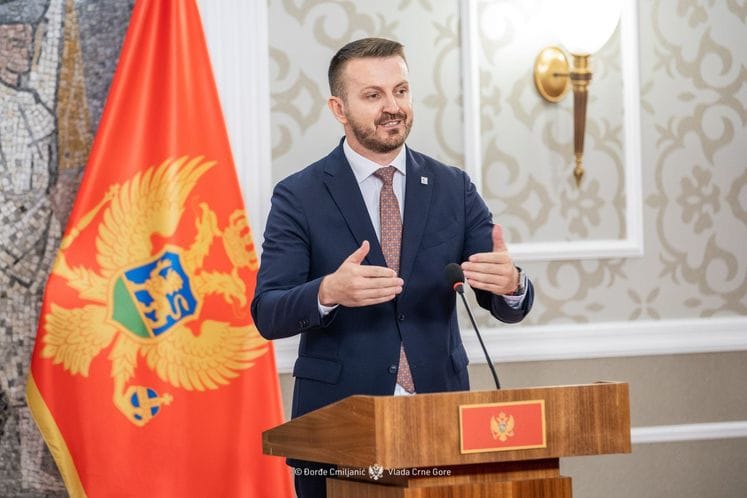
The International Day of Public Administration is an opportunity to speak about our goal – an efficient and depoliticized public administration that aligns with modern trends and serves both citizens and the economy.
On this journey, I would say we have left behind the longest and most difficult stretch. Today, we will speak about what we have accomplished together and what still lies ahead.
However, first and foremost, it is important to highlight what is undoubtedly our greatest success – the achievement that gives meaning and sustainability to all our efforts.
Our greatest accomplishment is the mutual trust between us and our partners. And our partners are all those with whom we jointly work on reforming and transforming our society. These include international institutions and organizations, our national and local government bodies, domestic and foreign experts, civil society, the academic and IT communities, the media, and, of course, the citizens – those for whom, and in whose interest, all of these efforts are undertaken.
A partnership built on trust removes the barriers of difference and paves the way for open exchange of ideas and experiences as we continue toward our shared objective.
Allow me to recall a few important events and activities we successfully completed together in the past year, which gave public administration a renewed and truly reform-oriented momentum.
We have taken a systemic approach – designing key laws under the Ministry’s jurisdiction in line with European standards, aiming at the depoliticization, optimization, and rationalization of public administration.
We finalized the Laws on Civil Servants, on Free Access to Information, and – of particular significance, as this is the first time – the Law on Government...
We opened the door to digital transformation and laid solid foundations for the modernization of public administration. We launched a new e-Government portal, introduced new electronic services, implemented EDMs, CA, GSB, and carried out other vital steps towards full digitalization of public administration. We also established the Open Data Portal.
We have established all the necessary conditions—legal, logistical, and strategic—for the creation of the Cybersecurity Agency, whose mandate will be to protect critical infrastructure, the economy, and citizens in the digital space. This is clearly defined in the Law on Information Security, which we have aligned with European standards—specifically, the NIS 2 Directive—making us the only country in the region to do so. We have laid the groundwork to elevate our cybersecurity to a significantly higher level, because only a digitally secure state can develop sustainable functionality. The next steps in this area depend on the Government, as the Ministry completed its part of the work more than six months ago.
We have established a Cyber Incident Response Team (CIRT) and the Government Security Operations Center (GSOC). Together with our partners, we have also established the Regional Cybersecurity Center (WB3C), thereby providing our country with what it needs most—a genuine opportunity to become a hub for the exchange of knowledge and best practices from around the world.
From the Government’s Reform Agenda, we fulfilled all of the Ministry's obligations within just eight months.
Decentralization, as a measure of democracy, is one of our key goals, and we have already come a long way toward achieving it.
We have prepared a new Law on Local Self-Government, which introduces a number of essential democratic advancements aimed at making local governments sustainable and functional.
Our cooperation with municipalities has reached the highest level through the "Municipalities for the EU" Memorandum, which outlines the responsibilities of key ministries and local authorities.
Together with our international partners, we are supporting municipalities in preparing for accelerated digital transformation and development.
Together with experts from relevant institutions and civil society, we have prepared the Draft Concept of the Law on Local Elections and submitted it to the Parliament. In doing so, we have made a concrete contribution to the reform of electoral legislation—one of the most important political topics (and a key element) for Montenegro’s continued European and democratic development.
Our achievements have been recognized beyond the borders of Montenegro. In Estonia—one of the world’s digital pioneers—Montenegro was named “Cybersecurity Partner of the Year 2025.”
We are the only institution in Montenegro to have received the status of an Effective CAF Model User.
We have signed multiple memoranda of cooperation with international partners and hosted high-ranking foreign officials—including the President of the European Commission, the Deputy Secretary General of NATO, and the Presidents of the Czech Republic, Estonia, and Moldova. All of them expressed interest in the progress we’ve made in the field of cybersecurity, because cyberspace is, in essence, unified and indivisible.
Success is gratifying, but we must not allow ourselves to become complacent. Much work still lies ahead. And yet, I remain optimistic.
This is not merely a story about the Ministry of Public Administration. It is a story of a partnership-based system built on trust—a system that learns, adapts, and evolves. It is the story of how a country, when it is both willing and capable, achieves its goals and accumulates success—without politicization, without unnecessary tensions, without opposition at all costs, and without narrow political interests taking precedence.
Our joint accomplishments are clear evidence that only through genuine mutual trust can we attain European standards and successfully navigate the final stage of our long journey toward the EU—not merely as a political aspiration, but above all as a value-based and civilizational framework in which the citizen, society, and the public interest are placed at the forefront.
As Minister, I owe profound gratitude to all our partners, collaborators, and the entire team at the Ministry.
We continue—together!