
- Home
Press release from the 92nd Cabinet session
Press release from the 92nd Cabinet session

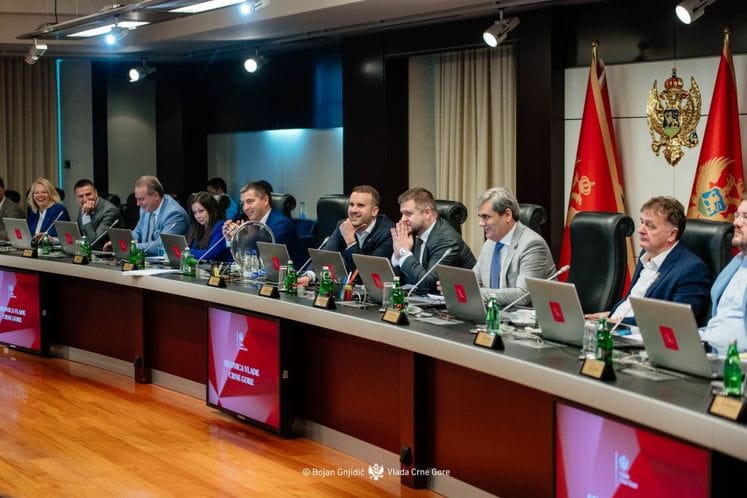
The Montenegrin Cabinet held its 92nd session today, chaired by Prime Minister Milojko Spajić.
The Cabinet adopted the Draft Law on Amendments to the Law on the Prevention of Illegal Business Activities, together with the Report from the Public Consultation. The proposed legal changes are intended to improve tax discipline among taxpayers, prevent the operation of unregistered businesses, and block the establishment of companies that do not comply with the law. The amendments foresee new powers for the Tax Administration, including the authority to block the bank accounts of business entities and entrepreneurs who have not registered or aligned their legal acts and organizational structure with the Law on Business Organizations, as well as those entities that were legally obligated but failed to register in the relevant registry. Additionally, the proposed amendments aim to facilitate business operations by allowing taxpayers to transfer funds not only through bank accounts but also through licensed payment institutions or electronic money institutions, in accordance with laws governing payment transactions. Gambling operators will be permitted to set a higher cash register limit than the prescribed maximum, but only with prior approval from the Tax Administration. Furthermore, in order to prevent tax avoidance through bankruptcy or liquidation followed by the establishment of new companies, the amendments introduce a ban on the establishment of new business entities or the registration of entrepreneurs for individuals under bankruptcy or liquidation, or for those who hold more than 25% ownership in companies that are in such procedures and have unsettled tax obligations or blocked accounts under enforced collection procedures. These individuals will also be prohibited from acquiring shares or equity in other companies or becoming members of other business entities, except in cases where shares or equity are inherited or acquired through a final court ruling. The proposed amendments are expected to contribute significantly to the suppression of the grey economy and the prevention of tax evasion.
The Cabinet adopted the Information on the Analysis of Digital Flows and Tools in Montenegrin Tourism. The aim of the analysis was to assess the current state of digital tools used for tourist registration, identify key challenges, and propose the development of a unified Tourist Information System (TIS), in line with the 2022–2026 Reform Agenda and national digital transformation strategies. The analysis highlighted the lack of a unified, interoperable system, noting that dozens of fragmented software solutions are currently in use, many of which are not integrated with central systems or with each other. The introduction of the TIS is therefore recognized as a strategic priority for the Government. The system will function as a centralized platform for the registration of tourists and accommodation facilities, as well as the management of registrations, deregistrations, and tourist taxes. It will enable timely, accurate, and real-time access to data for all relevant institutions, supporting better coordination and planning. The TIS is expected to contribute to reducing the grey economy, easing administrative burdens, and boosting tax revenues, while strengthening the competitiveness of the tourism sector. The Ministry of Tourism and the Ministry of Public Administration were tasked with continuing activities toward the implementation of the system, ensuring improved data transparency, automation of processes, and enhanced institutional efficiency.
The Cabinet adopted the Immunization Programme 2026-2028 along with its Action Plan, marking the first time such a comprehensive document has been created in Montenegro. The Programme is aimed at increasing vaccination coverage, particularly among vulnerable groups such as children, rebuilding public trust in vaccination, and improving access to vaccines and immunization services. As emphasized during the session, this is not only a response to current health challenges but also a medium-term strategy to improve public health and well-being, laying a foundation for a healthier society. The successful implementation of this Programme will require close cooperation between the health, education, and civil sectors, in order to reach immunization goals that ensure greater protection and a higher quality of life for all citizens. The total budget required for the implementation of the Action Plan for the period 2026–2028 is €607,050, with €222,350 allocated for 2026, and €192,350 allocated for both 2027 and 2028.
The Cabinet adopted the Information on the Additional Financial Resources Required for the Autumn 2025 Oral Rabies Vaccination Campaign for Foxes, approving the allocation of €36,850. The campaign, which is a part of Montenegro’s obligations under Chapter 12 of the EU accession negotiations, includes two rounds of oral vaccination annually (spring and autumn), during which 275,000 vaccine baits are distributed per campaign, for a total of 550,000 annually. Due to a funding gap caused by EU limitations under the HADEA grant, which allows for a maximum price of €0.95 + 7% overheads per bait, while the actual minimum cost is €1.15, the Cabinet approved the additional funds needed to cover the difference.
The Cabinet adopted the Forest Management Programme for 2025, with funding provided through the national budget in the amount of €7,497,959. The Programme outlines annual forest management measures in accordance with the Law on Forests, detailing their scope, type, and implementation timeline. The goal is to ensure sustainable management and preservation of forest resources, supporting natural regeneration, ecological stability, biodiversity protection, and improved forest yield and quality.
The Cabinet adopted the Decision and Annual Plan for the Establishment and Maintenance of Mandatory Oil Reserves for 2025. The plan defines the amount of reserves to be formed by 30 June 2026, financial resources required for procurement, storage capacities, procurement policy, and other key activities of the Directorate responsible for managing oil reserves. Based on import and consumption data for 2024, the total quantity of mandatory reserves has been set at 112,340 metric tons—equivalent to 90 days of net oil imports. This is one of three essential benchmarks for closing Chapter 15 – Energy in Montenegro’s EU accession negotiations.
The Cabinet adopted the Information on the Financing Agreement between the United Nations Development Programme (UNDP) and the Ministry of Interior, aimed at implementing the Cooperation Programme 2025–2027. The agreement addresses a key challenge – the provision of essential uniforms for police officers, which are a core part of the institution’s visual identity and operational legitimacy. The last major uniform procurement was carried out in 2016. The total value of the project is €4,434,477, with funds to be provided in two installments: the first, in the amount of €1,934,477, is planned for September 2025, and the second, totaling €2,500,000, is scheduled for April 2026. The project has been recognized as a multi-year initiative in the national budget, and funds for the first installment have already been secured under the Ministry of Interior’s budgetary allocation.
