
- Home
Press release from the 93rd Cabinet session
Press release from the 93rd Cabinet session

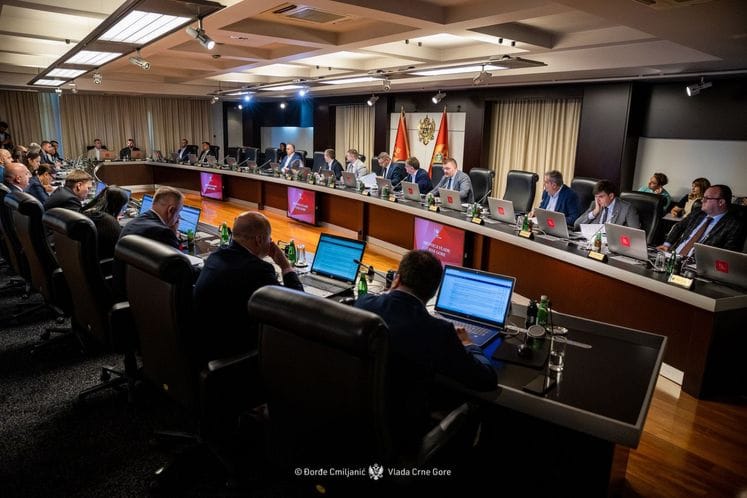
The Montenegrin Cabinet held its 93rd session today, chaired by Deputy Prime Minister Aleksa Bečić. The Cabinet adopted the Draft Law on cooperation of Montenegro with the diaspora – emigrants. The draft law improves the existing legal framework by establishing the Ministry of Diaspora as the central body responsible for leading and coordinating all activities related to the diaspora. This ensures that the diaspora has a single point of contact, while also creating the conditions for more efficient functioning of the Council for cooperation with the diaspora – emigrants, and for the design and implementation of new programmes of the Ministry of Diaspora. Compared to the current law, the allocation of budgetary funds is increased: instead of 0.07% of the current state budget, at least 0.20% of the budget of Montenegro will be earmarked for preserving and strengthening cooperation with the diaspora. A new article has been introduced, detailing the provision of support to returnees in the process of return, reintegration, and exercising of rights in Montenegro, as well as mechanisms for financing and maintaining records. Furthermore, the Ministry of Diaspora will establish and maintain the Register of the diaspora – emigrants in electronic form, replacing the current record system. The law also envisages the organisation of a Summer school of language and culture “Montenegro – My Homeland” for children from the diaspora, with the aim of strengthening both educational and cultural ties.
The Cabinet adopted the Draft Law on amendments to the Law on the enforcement of suspended sentences and community service. The proposed amendments contribute to the development of an efficient system of alternative sanctions, based on strengthened institutional and human capacities of the Directorate responsible for their implementation within the Ministry of Justice. The objective is to ensure effective supervision of offenders subject to alternative sanctions and conditional release, while further strengthening the application of such measures. This reduces the prison population, enhances trust of judicial institutions in the system of alternative sanctions, and addresses shortcomings identified in the current law, thereby improving the legal framework for more effective implementation.
The Cabinet adopted the Draft Law on ratification of the Third and Fourth Additional Protocols to the European Convention on Extradition. The need to expand the extradition system in line with modern challenges, as well as the goal of updating the legal instruments of the Council of Europe in the field of criminal justice, have led to the adoption of the Third Additional Protocol (2010) and the Fourth Additional Protocol (2012) to the European Convention on Extradition. These protocols supplement and modernise the Convention, reflecting developments in international cooperation in criminal matters since its entry into force. Their ratification will ensure more effective combat against crime, stronger international cooperation, and better protection of human rights. The Third Protocol introduces the simplified extradition mechanism, allowing extradition procedures to be shortened when the person concerned consents to extradition, reducing procedural delays and administrative burdens. The Fourth Protocol modernises certain provisions of the Convention, introducing clearer deadlines, permitting electronic communication, and strengthening the rights of extradited persons. The overall aim is to ensure continuity in strengthening international cooperation, particularly in combating cross-border crime, within the framework of Chapter 24 – Justice, Freedom and Security of the EU accession negotiations. Judicial cooperation in civil and criminal matters is one of the key priorities, and Montenegro’s EU Accession Programme 2025–2026 defines the ratification of these protocols among the most important tasks.
The Cabinet adopted the Information on the temporary suspension of recognition of foreign educational qualifications for employment purposes, obtained at the College of Service Business, East Sarajevo – Sokolac, Bosnia and Herzegovina, in order to protect the public interest. According to data provided by the ENIC Centre of the Ministry of Education, Science and Innovation, the number of applications for recognition of diplomas from this institution has been steadily increasing: 28 applications in 2022, 39 applications in 2023, and 37 applications in 2024, all positively resolved. Since the beginning of 2025, 33 applications have been submitted, of which 10 have been positively resolved and 23 are pending. The age of applicants ranges from 22 to 47, with the majority having acquired higher education while in employment, raising concerns regarding the legitimacy of their studies. Of the 33 applications in 2025, 27 are for qualifications in Security Studies, and 6 in Law and Economics. Notably, 22 applicants completed their studies at this institution through transfers from other universities in Montenegro or abroad, finalising their degree by taking a minimal number of exams. Given these circumstances, the Government instructed the Ministry of Education, Science and Innovation to temporarily suspend recognition of qualifications from this institution until official information is obtained from the Ministry of Education of Bosnia and Herzegovina and the Agency for the Development of Higher Education and Quality Assurance of Bosnia and Herzegovina (HEA) on the conditions of enrolment, transfers, and awarding of qualifications at the College of Service Business.
The Cabinet adopted the Decision on the publication of the Agreement between Montenegro and the European Union on Montenegro’s participation in the LIFE programme – the EU programme for the environment and climate action (with Annexes I and II). The signing of the LIFE financial programme forms part of Montenegro’s wider integration process, aiming at alignment with EU policies and standards in the areas of environmental protection and climate action. As a candidate country, Montenegro already has access to EU funds through instruments such as IPA, but participation in the LIFE programme opens up direct financing opportunities for priority projects in environmental protection, which were previously available only to EU Member States. Launched in 1992, LIFE is the EU’s flagship funding instrument for the environment and climate change. The current LIFE 2021–2027 Programme is the only EU programme fully dedicated to ecological, climate, and energy objectives, with two main fields (environment and climate action) and four sub-programmes:
- Nature and Biodiversity
- Circular Economy and Quality of Life
- Climate Change Mitigation and Adaptation
- Clean Energy Transition
Montenegro’s participation in LIFE will provide substantial support for innovative projects, contribute to achieving the country’s sustainable development and climate objectives, and facilitate stronger integration into European and international environmental initiatives.
