
- Home
DPM Bečić meets with PACE co-rapporteur Liliana Ta...
DPM Bečić meets with PACE co-rapporteur Liliana Tanguy

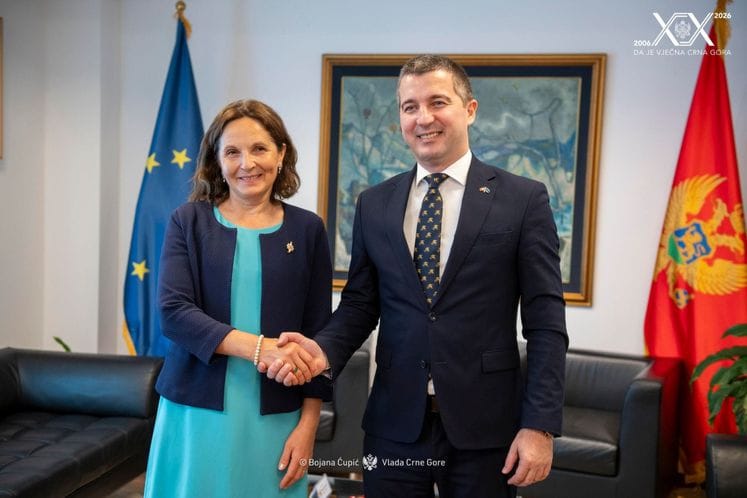
Deputy Prime Minister Aleksa Bečić met today with Liliana Tanguy, co-rapporteur of the Parliamentary Assembly of the Council of Europe (PACE) for the post-monitoring dialogue with Montenegro, who is visiting the country together with a PACE delegation on a four-day mission.
Welcoming the delegation, Bečić noted that their visit comes immediately after the successful EU–Western Balkans Leaders’ Summit held in Tivat, the largest international event organized by Montenegro in its recent history.
He said that the event had been flawlessly organized, with the security sector serving as the backbone of the operation, and that participants had conveyed highly encouraging and unified messages, expressing strong confidence in Montenegro and confirming that the country is firmly advancing towards its strategic goal of EU membership by 2028.
Speaking about European integration, Bečić recalled that Montenegro had, over the past three years, unblocked a process that had stagnated for years, secured the historic IBAR in Chapters 23 and 24, and provisionally closed eleven negotiating chapters, with two more expected to be closed soon.
He stressed that the 44th Government closely monitors the implementation of EU-related obligations at every session and expressed confidence that, thanks to the current reform momentum, Montenegro would complete the negotiating process within the envisaged timeframe and further strengthen its position as the next member state of the European Union.
Bečić reiterated that Montenegro remains firmly committed to its three key foreign policy priorities: membership in the European Union, a stable and reliable partnership within NATO, and the strengthening of regional stability and good-neighbourly relations.
Addressing reforms in the security sector, Bečić emphasized that integrity remains an absolute priority and that the sector must be free from any criminal or undue influence.
He said that, until only a few years ago, Montenegro had been recognized by European institutions as a country marked by captured institutions, endemic corruption and elements of a hybrid regime. According to Bečić, these circumstances had blocked the country's European integration process for years, particularly in Chapters 23 and 24.
He further noted that two major drug cartels had emerged during that period and had, at one point, infiltrated state institutions. Those linked to criminal structures, he said, continue attempting to divert public attention because every action taken by the state against organized crime is becoming increasingly effective.
Bečić added that resistance to reforms is to be expected from those who benefited from the previous system, stressing that the current leadership of the security sector cannot be influenced, intimidated, blackmailed or discouraged by smear campaigns, hybrid attacks or attempts to obstruct reforms.
He underlined that the Director of the Police Directorate is a professional who applies the law equally to everyone and stated that the era of captured institutions and individuals serving criminal networks belongs to the past.
Bečić emphasized that Montenegro's achievements in the fight against organized crime and corruption are also reflected in the strong confidence and support the country enjoys from its international partners.
Without intensive cooperation and the high level of trust that Montenegro’s intelligence and security sector currently enjoys among international partners, such results would not have been possible, he said.
Bečić noted that the Government inherited a system deeply compromised by decades of institutional capture. He pointed to the fact that a number of former holders of the highest positions in the judiciary and security sector have been prosecuted, with some already receiving first-instance convictions or facing confirmed indictments for serious criminal offences. According to him, strengthening integrity and cleansing institutions through lawful mechanisms are essential preconditions for restoring the health of the state and ensuring an effective fight against organized crime and corruption.
He added that the Government is simultaneously implementing legislative and personnel reforms, while remaining fully committed to the rule of law and European standards. There is no individual who can be stronger than the state, nor will anyone be above the law, Bečić said.
The PACE co-rapporteur thanked Bečić for the warm welcome and hospitality, stressing that the purpose of the visit is to assess Montenegro’s fulfilment of obligations stemming from the core values of the Council of Europe, including the rule of law, human rights protection, freedom of expression, media freedom and the strengthening of democratic institutions.
She underlined that the PACE’s report should serve as support and contribute to Montenegro’s further progress on its European path.
The interlocutors agreed that the continuation of reforms, the strengthening of the rule of law and institutions, and the preservation of political stability remain key prerequisites for the successful completion of Montenegro’s EU accession negotiations and the further democratization of Montenegrin society.