
- Government of Montenegro
Ibrahimović in Geneva: Human rights are the founda...
Ibrahimović in Geneva: Human rights are the foundation of peace and international security, and multilateralism a strategic investment

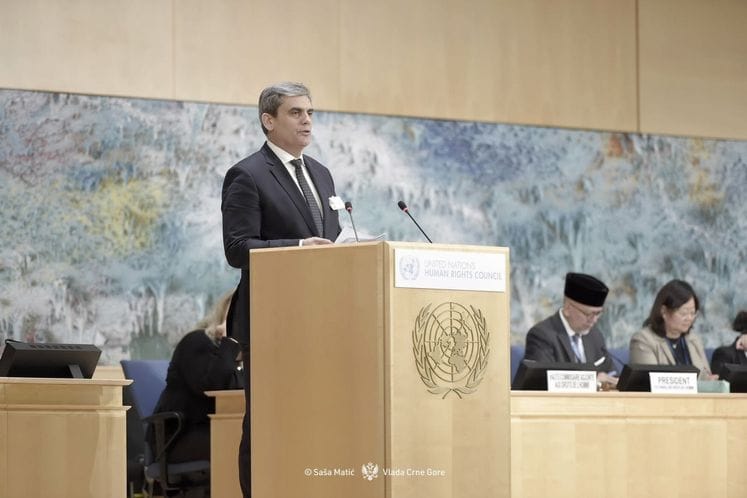
Deputy Prime Minister and Minister of Foreign Affairs Ervin Ibrahimović participated in the High-Level Segment of the 61st session of the United Nations Human Rights Council in Geneva. The session was opened by Secretary-General of the United Nations António Guterres, President of the UN General Assembly Annalena Baerbock, UN High Commissioner for Human Rights Volker Türk, President of UN Human Rights Council Sidharto Reza Suryodipuro, and Head of the Federal Department of Foreign Affairs of the Swiss Confederation Ignazio Cassis.
In his address during the plenary debate, Ibrahimović underlined that the international system is facing serious pressures due to armed conflicts, violations of international law, and declining trust in multilateral institutions. He stressed that the principles of the UN Charter – sovereignty, territorial integrity, human rights, and the peaceful settlement of disputes – cannot be applied selectively, as they constitute the foundation of international peace and security.
He recalled the importance of the Human Rights Council’s role in strengthening accountability and protecting human rights worldwide. He emphasized that the Council must remain principled, impartial, and grounded in objectivity and dialogue, particularly in situations of serious human rights violations, and that conditions for its independent functioning must be preserved.
He welcomed the initiative of the UN High Commissioner for Human Rights to establish a Global Alliance for Human Rights.
Ibrahimović noted that 2026 holds special significance for Montenegro, marking twenty years since the restoration of independence, as well as a year in which Montenegro aims to conclude negotiations for membership in the European Union. He highlighted the coherence between Montenegro’s European path and its engagement in the Human Rights Council within the broader multilateral framework.
On the margins of the session, Ibrahimović met with President of UN Human Rights Council Sidharto Reza Suryodipuro, emphasizing Montenegro’s strong support for the Council’s mandate, as demonstrated through active participation in all its segments, a constructive approach, and committed partnership, with particular emphasis on the Council’s preventive role in cases of grave violations and crimes.
In a separate meeting with President of the UN General Assembly Annalena Baerbock, Ibrahimović expressed support for her work and exchanged views on the ongoing UN80 reform process, with particular attention to the human rights pillar. Ibrahimović advocated strengthening the link between New York and Geneva and preserving effective multilateralism as a guarantee of global stability and security.
Ibrahimović also met with UN High Commissioner for Human Rights Volker Türk, welcoming his leadership and principled action in complex international circumstances and amid challenges to multilateralism. He emphasized that Montenegro, as a NATO member and EU candidate country, remains firmly committed to human rights principles and standards and continues to pursue a policy of a reliable partner and promoter of these values in the region, in strong partnership with the United Nations.
During his stay in Geneva, Ibrahimović met with the UN High Commissioner for Refugees Barham Salih, congratulating him on his appointment to head a key UN entity in the field of humanitarian assistance and support. It was emphasized that Montenegro highly values its decades-long cooperation with UNHCR, which, inter alia, resulted in the closure of the refugee chapter in Montenegro and across the territory of the former Yugoslavia, as well as the strengthening of institutional capacities for effective crisis management.
At the conclusion of the visit, Ibrahimović stated that for Montenegro, multilateralism is a matter of strategic security. As a demographically small state, Montenegro supports a system in which rules protect the equality of states and limit the politics of force, and therefore consistently supports strengthening the role of the United Nations.
