

- Home
Ibrahimović, Tissot: Confronting the past is the o...
Ibrahimović, Tissot: Confronting the past is the only path to lasting peace and reconciliation

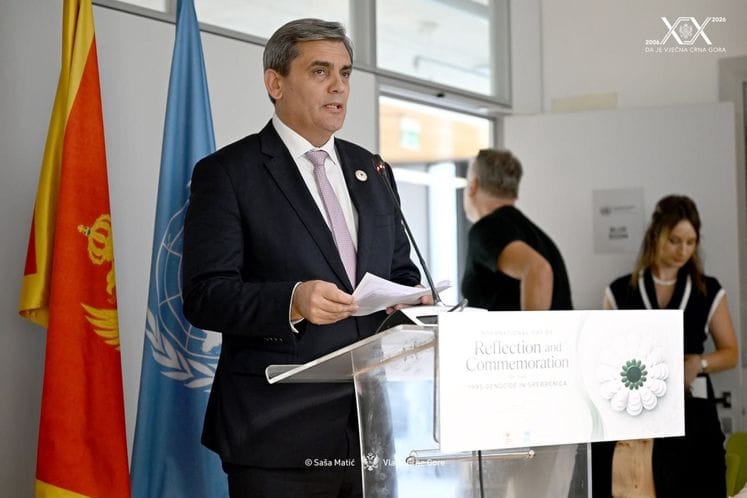
Deputy Prime Minister and Minister of Foreign Affairs Ervin Ibrahimović, together with UN Resident Coordinator in Montenegro Caroline Tissot, today opened a panel discussion marking the International Day of Reflection and Commemoration of the 1995 Genocide in Srebrenica.
The event began with a minute of silence in honour of the victims of the Srebrenica genocide.
Addressing the audience, Ibrahimović stressed that, 31 years after the genocide in Srebrenica, this horrific crime remains a lasting warning to humanity and a reminder of the obligation to preserve the truth, ensure justice and foster a culture of remembrance. He noted that the observance of the International Day of Reflection and Commemoration, established by the 2024 United Nations General Assembly Resolution, reaffirms Montenegro's commitment to internationally accepted obligations and to the values of peace, human dignity, respect for international law and the rulings of international courts.
He said that preserving a culture of remembrance is the strongest response to historical revisionism, genocide denial, the glorification of war criminals and hate speech. He recalled that Montenegro has consistently demonstrated its principled position on the Srebrenica genocide through the resolutions adopted by the Parliament of Montenegro and its support for the 2024 UN General Assembly Resolution.
I firmly believe that lasting peace in the region is possible only through confronting the dark chapters of the past, establishing the truth and bringing those responsible to justice. This is a prerequisite for building healthy societies that are resilient to all forms of human rights violations. By remaining committed to discussing the past and accepting responsibility, we take another step towards genuine understanding and reconciliation, and thus towards the prosperity and unity of future generations in Montenegro and the region, Ibrahimović said.
The International Criminal Tribunal for the former Yugoslavia and the International Court of Justice have ruled that genocide was committed in Srebrenica. Establishing the truth and ensuring justice are essential for the victims, their families and societies striving to build a peaceful future. Justice must be delivered to the victims and their families, while institutions and civil society must be strengthened to prevent future atrocities. Today, we remember the past not only to honour the victims, but also to reaffirm our shared responsibility to build a present and future founded on dignity, respect for human rights and the determination that such crimes must never happen again, UN Resident Coordinator Caroline Tissot stated.
Participants also heard a video message from Director of the Srebrenica–Potočari Memorial Center Emir Suljagić. The victims of the Srebrenica genocide can no longer speak. That is why it is our duty to ensure that their voices are never silenced. We remember, we bear witness and we insist on the truth. Because remembrance is an act of justice, and truth is the strongest safeguard against the repetition of such crimes, he said.
The event continued with a panel discussion featuring Branimir Jukić, Ambassador of Bosnia and Herzegovina to Montenegro, Peter Felten, Ambassador of the Federal Republic of Germany to Montenegro, Siniša Bjeković, Protector of Human Rights and Freedoms of Montenegro, and Tea Gorjanc Prelević, Executive Director of Human Rights Action. The discussion was moderated by Anjet Lanting, Human Rights Adviser at the Office of the UN Resident Coordinator in Montenegro and the Office of the United Nations High Commissioner for Human Rights.
The panel concluded that remembering the victims remains a lasting responsibility and a reminder that truth, justice, dialogue and respect for human rights are the foundations of a peaceful, secure and prosperous future.
