
- Home
Ivanović at Adria Future Summit: Successful Europe...
Ivanović at Adria Future Summit: Successful European integration brings the greatest benefits to young people

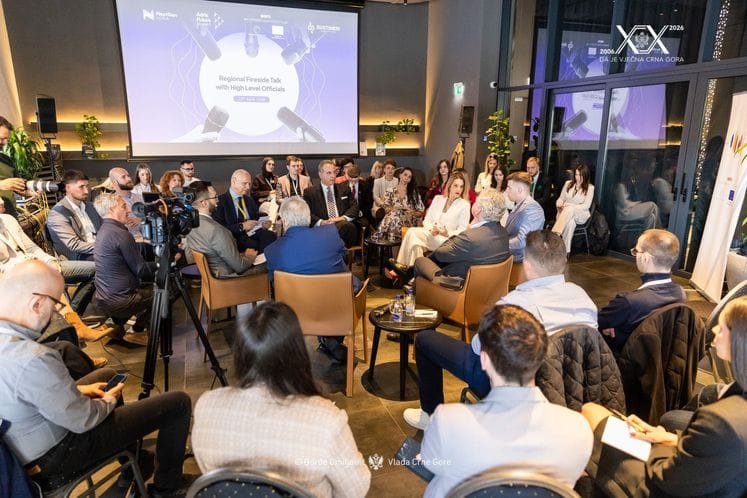
Deputy Prime Minister for Foreign and European Affairs Filip Ivanović participated in a regional session within the Adria Future Summit 2026 in Tivat, dedicated to enhancing dialogue between young people and decision-makers.
During the discussion, it was highlighted that Montenegro is making consistent progress in the European integration process, which has been recognised by international partners, with the assessment that the country not only declaratively supports the European path but is achieving concrete results.
Today, young people have more opportunities than before, but at the same time also more challenges. It is crucial that they remain active, continuously learn, and critically assess the information available to them, Ivanović said, recalling the differences between generations that grew up in the 1990s and today’s circumstances marked by rapid technological development.
Speaking about the European perspective, Ivanović stressed that membership in the European Union is a long-standing goal of Montenegro, and that the country is now in the final phase of that process.
This goal cannot be achieved without the energy and critical thinking of young people. European integration brings concrete benefits, such as greater mobility, better connectivity, and broader professional opportunities. We are doing this for society as a whole, but above all for young people and their future. Everything being done within the European integration process is aimed at young people and their future, so that they can build a perspective without the burdens carried by previous generations, Ivanović said.
Responding to questions from young participants about their role in society and the European process, the Deputy Prime Minister emphasised that young people are key promoters of Montenegro’s values.
Through every form of engagement, young people carry and represent the identity of Montenegro, its culture, history and values, thereby making an important contribution to its international affirmation, Ivanović noted.
Speaking about the challenge of retaining young people in the country, he pointed to the need to create a supportive environment for living and working.
The goal is to provide conditions in which young people want to stay, through strengthening the labour market, increasing wages and improving the quality of life. In this direction, significant progress has already been achieved, including salary increases in recent years, he said.
Participants of the panel agreed that young people must be actively involved in public policymaking, and that their role should not be marginalised but integrated into broader development strategies of the region.
The session also featured Secretary General of the Regional Cooperation Council Amer Kapetanović, Ambassador of the European Union to Montenegro Johann Sattler, Ambassador of Ireland to Serbia and Montenegro Kevin Colgan, and the founder of the Adria Future Summit Biljana Braithwaite, who highlighted the importance of continuous inclusion of young people in decision-making processes, strengthening regional cooperation, and using European experiences as a driver of further development.
The session brought together young people from the Western Balkans region, who had the opportunity to directly ask questions and engage in an open dialogue with decision-makers through an interactive format, aimed at strengthening their role in processes shaping the region’s future.
