

- Home
Koprivica: Montenegro shows strong political will ...
Koprivica: Montenegro shows strong political will to tackle tobacco smuggling and trafficking

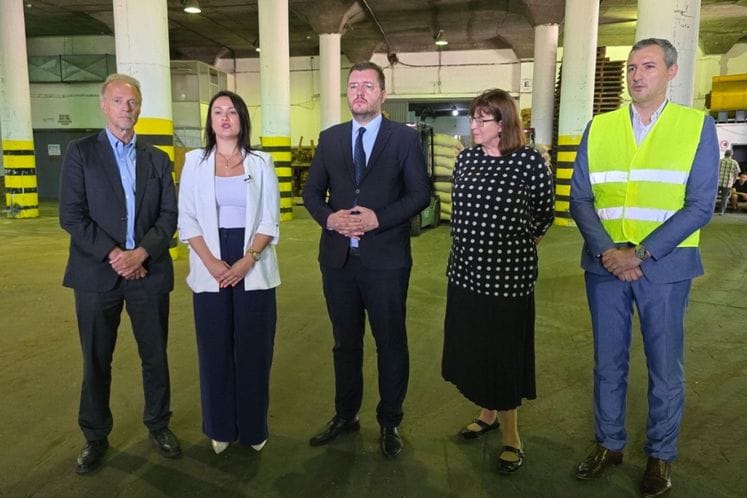
Deputy Prime Minister for Political System, Justice and Anti‑Corruption Momo Koprivica visited the warehouse at Free Zone of the Port of Bar, where seized tobacco is being destroyed. He was accompanied by British Ambassador to Montenegro Dawn McKen, Head of Cooperation at the EU Delegation to Montenegro Yngve Engström, Customs Administration Director Maja Vučinić, and Aleksandar Božović, Executive Director of Deponija, the company tasked with implementing the destruction process.
Koprivica noted that the operation has proceeded according to schedule over the past 13 working days and in line with the government’s decision. He hailed the initiative as historic, underscoring Montenegro’s firm political resolve to confront smuggling and illicit trade. He emphasized that this process is not merely technical, but a demonstration of strong political will—a message that Montenegro is no longer a safe haven for smugglers. With this action, institutions are being reclaimed to serve the public interest, not private agendas. For years it was said that the state couldn't stand up to the tobacco mafia. We are proving otherwise—that this marks a turning point in the fight for the rule of law, Koprivica declared. He added that the destruction process is a structured and credible operation, grounded in international partnership. He expressed gratitude to the British and EU embassies, as well as HMRC, for their legal and operational assistance and for helping to establish a transparent methodology—clear evidence of Montenegro’s full commitment to international cooperation in combating transnational crime and corruption.
Koprivica stressed that this process aligns with the European agenda and standards and proves readiness to close key negotiation chapters with the EU. He added that destroying smuggled tobacco protects legitimate industry and delivers excise revenue into the national budget. The state doesn’t lose—it actually gains, he said.
I am very pleased to witness this important step by Montenegro in its fight against organized crime. The government has shown determination in carrying out tobacco destruction transparently and credibly, and the UK was proud to contribute through HMRC monitoring and the operational plan. We are also delighted to have collaborated with the EU Delegation and the EUROL 4 programme, British Ambassador Dawn McKen commented.
This is a good day for Montenegro. Fighting organized crime requires practical work and credible results. The EU will continue to strongly support Montenegro in the rule‑of‑law area, Head of Cooperation at the EU Delegation to Montenegro Yngve Engström.
Customs Administration Director Maja Vučinić confirmed that from 23 June until 8 July, Montenegro destroyed 325 tonnes of smuggled tobacco (equivalent to 21,000 packs), following established methodology. She emphasized the operation's role in protecting public trust, enforcing the rule of law, and safeguarding Montenegro’s financial interests. The Customs Administration also highlighted the formal agreement with a licensed waste‑management firm for safe disposal within 90 days, overseen by a coordination team.
At the beginning of the visit, Executive Director of Deponija Aleksandar Božović briefed those present on the destruction process, emphasizing his gratitude to the Government of Montenegro for entrusting the Podgorica-based company with such a significant and historic task.
According to Božović, the destruction procedure is straightforward and highly effective. Every piece of confiscated tobacco, still in its original factory packaging — including packets and cellophane — is ground on site, within the warehouse premises, using industrial shredders. The material is pulverized into a fine, unrecognizable, and unusable form. It is then mixed with cardboard and other neutralizing materials and transported, under strict conditions and with police escort, to the sanitary landfill. Once at the landfill, approximately 35 tons of destroyed tobacco per day are combined with around 350 tons of municipal waste received daily. This mixture is then covered with layers of material designed specifically for landfill insulation and protection. In the end, Božović emphasized, the process ensures that not a single gram of the confiscated tobacco can be reused or extracted.
