
- Home
Montenegro expects to become EU member in 2028: Bu...
Montenegro expects to become EU member in 2028: Bulgaria among Its key supporters

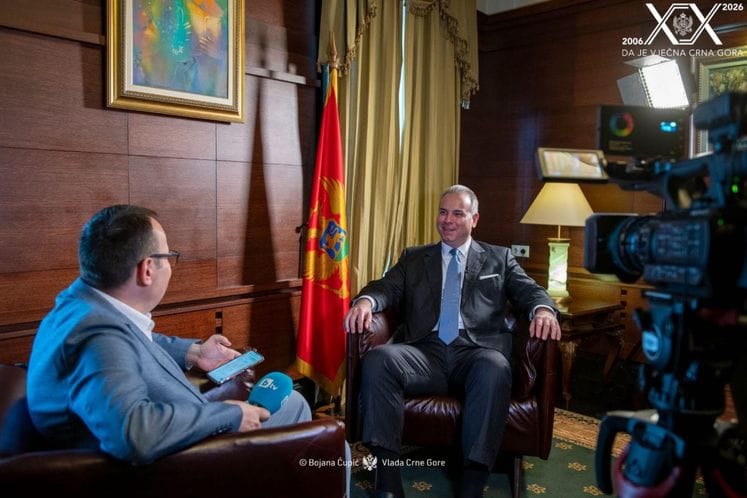
Statement by Deputy Prime Minister of Montenegro Filip Ivanović in an interview with Nikolay Krestev, published on 17 October 2026
Montenegro could become a full member of the European Union in 2028, Deputy Prime Minister Filip Ivanović stated.
1. Progress in EU accession negotiations
Montenegro has been negotiating EU accession for 14 years, but the process has accelerated significantly over the past three and a half years. According to the article, nearly 60% of the negotiating chapters have been provisionally closed and the remaining chapters are expected to be closed by the end of 2026.
The plan is to sign the Accession Treaty in 2027, followed by the ratification in all EU Member States. This would pave the way for Montenegro to become an EU member in 2028.
Ivanović considers this target ambitious but realistic, provided that Montenegro, the European Commission and the Member States continue working at the same pace.
2. What more does Montenegro need to do?
According to Ivanović, the key reforms have already been adopted and assessed. Progress in the following areas is particularly important:
- Rule of law,
- Combating organised crime,
- Fighting corruption.
In 2024, Montenegro received a positive report on its fulfilment of the interim benchmarks in these areas.
Nevertheless, further work remains to be completed, which the Deputy Prime Minister expects to happen soon, after which the European Commission would assess the progress achieved.
Chapter 27, which concerns environmental protection, represents a particular challenge. Ivanović considers it demanding but expects it to be successfully closed with technical assistance from the European Commission and EU Member States.
Certain constitutional amendments are also required, for which a two-thirds majority in the Parliament is necessary.
Ivanović emphasises that more than 75% of Montenegro’s citizens support EU membership and that there is broad political and social consensus on the country’s European path.
3. Bulgaria as important ally of Montenegro
Support from the EU Member States is essential for the provisional closure of negotiating chapters. Once negotiations are completed, the Accession Treaty will need to be ratified by all 27 Member States.
Montenegro has already initiated activities with all Member States to ensure that this process proceeds as quickly as possible.
Ivanović particularly highlights Bulgaria, describing it as a friendly country and ally that has strongly supported EU enlargement and Montenegro’s accession negotiations from the very beginning.
He expects Bulgaria to ratify the Accession Treaty quickly and without major difficulties. According to Ivanović, Montenegro is counting on Bulgaria’s support not only within EU institutions but also in discussions with representatives of other Member States.
4. Why would Montenegro’s membership strengthen EU?
Ivanović recalls that the European perspective of the Western Balkan countries was reaffirmed at the 2003 Thessaloniki Summit.
Croatia was the most recent country to join the EU, acceding in 2013. According to DPM Ivanović, the enlargement policy subsequently experienced a period of stagnation.
Over the past four and a half years, however, the approach to enlargement has changed. Meeting the required conditions and criteria remains paramount, but the process has also acquired a pronounced geopolitical dimension.
The EU increasingly recognises that enlargement contributes to collective security and strengthens its position in Europe and globally.
Montenegro and the other Western Balkan countries occupy a geostrategically important area between Europe and the Mediterranean. Ivanović believes that Montenegro’s successful accession, potentially followed by that of other countries in the region, would strengthen the EU, enhance its security and make it a more credible and attractive political community.
5. Russia’s war against Ukraine and security of Western Balkans
At the end of the interview, Ivanović discusses the impact of Russia’s war against Ukraine on the security of the Western Balkans.
He stresses that no conflict in the contemporary world is entirely detached from other countries. Wars in recent years, including Russia’s war against Ukraine, have affected the entire European continent, as well as countries aspiring to join the EU.
He therefore considers it necessary to accelerate the European integration of Montenegro and other candidate countries.
As he points out, there is no vacuum in international relations that would remain unfilled. Montenegro wants a stronger presence of European influence and values, from which the citizens of Montenegro and other countries would benefit.
Ivanović concludes that accelerating enlargement would reaffirm the credibility of the European Union, strengthen its geopolitical standing and security and demonstrate that EU membership remains an attractive goal for European countries.
The interview is available here.