

- Home
Press release from the 142nd Cabinet session
Press release from the 142nd Cabinet session

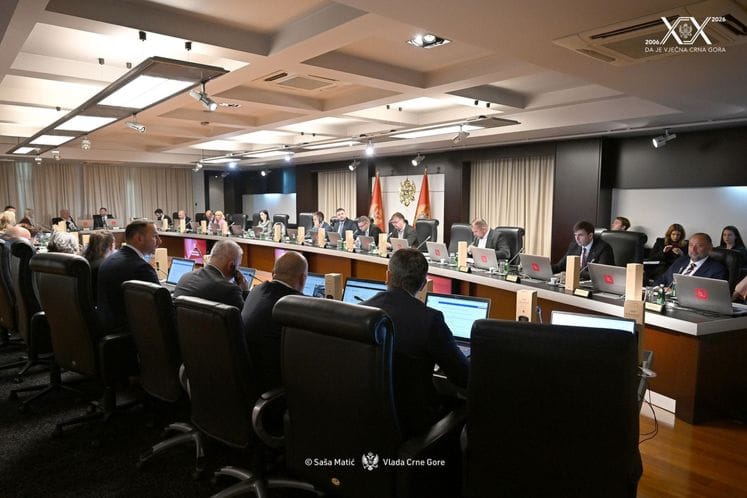
At its 142nd session held earlier today, chaired by Deputy Prime Minister Aleksa Bečić, the Montenegrin Cabinet adopted the Decision Amending the Decision on Granting Temporary Protection to Persons from Ukraine.
The Decision has been aligned with the provisions of Council of the European Union Implementing Decision (EU) 2026/1912 of 30 July 2026, introducing more restrictive measures for the Ukrainian nationals subject to military service who apply for temporary protection. Under the new provisions, temporary protection will be granted to such applicants only if they had been physically present in the territory of Ukraine before arriving in Montenegro and have either fulfilled their military service obligations in Ukraine or been exempted from them. This restriction will not apply to persons from Ukraine who already enjoy temporary protection in Montenegro.
The Cabinet also adopted the Unified List of Priority Infrastructure Projects in the Field of Environmental Protection.
As the Unified List of Priority Projects for the environmental protection sector was last updated in December 2021, the need arose to revise it. To this end, a sectoral working group was established to select priority projects in the field of environmental protection and assess their strategic importance.
The list comprises 102 projects with a total estimated value of EUR 1.5 billion. Funding for the implementation of these projects is envisaged through the Western Balkans Investment Framework (WBIF), all available EU financial programmes, the Instrument for Pre-Accession Assistance (IPA), and loans from development banks, including the European Investment Bank (EIB), the European Bank for Reconstruction and Development (EBRD), KfW, the Council of Europe Development Bank (CEB), the French Development Agency (AFD) and the World Bank.
The identified multiannual projects will be implemented in accordance with the established schedules and funding sources, which will be considered during the preparation of Montenegro's annual budget laws.
All projects have been successfully collected and processed for assessment of their strategic relevance in accordance with the Methodology for the Selection and Prioritisation of Infrastructure Projects. They have subsequently been included in the table forming part of the Unified List of Priority Projects for the environmental protection sector. The implementation units “Vodacom” and “Procon” participated in the preparation of the Unified List.
The Government adopted the Information on the Purchase of Lambs and Instructions on Records of Purchases and VAT Payments for 2026.
The Information states that an agreement was reached at a meeting attended by the Ministry of Social Welfare, Family Care and Demography, Ministry of Agriculture, Forestry and Water Management, Pension and Disability Insurance Fund, Association of Pensioners' Associations of Montenegro and representatives of the meat industry, namely “Mesopromet” from Bijelo Polje, “MI Goranović” from Nikšić and “KD Tuko” from Nikšić, to purchase surplus lambs from Montenegrin agricultural producers.
The purchase price will be EUR 4.75 per kilogram, while the fee for storage and withdrawal from the market will amount to EUR 19 per animal. It was also agreed that the purchased meat would be distributed to pensioners at a price of EUR 8.50 per month over an eight-month period, starting with the December pension payment. A total of EUR 320,000 has been allocated to support the purchase programme.
The Information states that, as in previous years, the purchased meat will be delivered to pensioners in Montenegro. Subsidies covering part of the purchase price will be provided by the Ministry of Social Welfare, Family Care and Demography and the Pension and Disability Insurance Fund of Montenegro. This will guarantee producers a secure market and timely payment, while making meat available to pensioners at more affordable prices.
According to the Information, pensioners will be able to purchase the meat in eight monthly instalments without interest.
This cooperation model was designed to address the market surplus of lambs by helping agricultural producers sell animals for which there is currently no market demand, while also enabling pensioners to purchase quality meat at subsidised prices.
The agreed model has enabled the meat industry to secure a reliable inflow of funds to finance purchasing activities and ensure the regular and timely payment of agricultural producers. In this way, stability has been maintained throughout the production and distribution chain, supporting both livestock farmers and meat processors.