

- Home
Borovinić Bojović: Telemedicine to improve access ...
Borovinić Bojović: Telemedicine to improve access to healthcare in remote areas

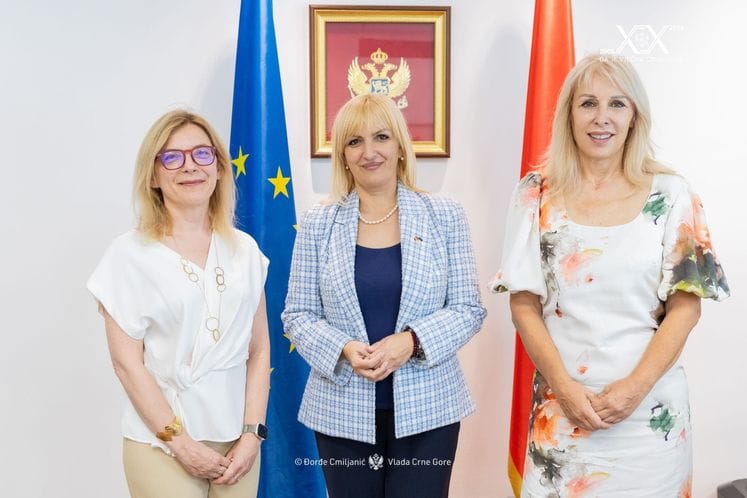
Deputy Prime Minister for Health and Social Welfare Jelena Borovinić Bojović met with Jana Belcheva Andreevska, an expert from North Macedonia, who presented experience from a telemedicine pilot project implemented through cooperation between NALAS, the Government and the relevant ministry.
The meeting was also attended by Mišela Manojlović, Secretary General of the Union of Municipalities of Montenegro, and focused on the possibility of applying this model in Montenegro, with adjustments to the needs of the national healthcare system.
The system presented enables the remote monitoring of basic health parameters and the digital transmission of data to healthcare professionals in real time. This makes it possible to continuously monitor patients living in inaccessible and remote areas, as well as patients with chronic conditions who, due to their health status, are unable to visit their doctor regularly, while ensuring appropriate monitoring of their health.
Deputy Prime Minister Borovinić Bojović expressed her support for the initiative, stressing that telemedicine could be particularly important for older people, patients with chronic conditions, persons with disabilities, and citizens living in rural and remote areas.
Telemedicine represents an important complement to the existing healthcare system, as it enables us to bring healthcare closer to citizens who, due to distance or limited mobility, have more difficulty accessing it. A pilot project in one Montenegrin municipality would be an important first step towards assessing its concrete benefits and potential for wider application, Borovinić Bojović said.
Expert Jana Belcheva Andreevska presented how the project operates and its results in the Municipality of Delčevo, highlighting its practical benefits for patients and healthcare professionals. She stressed that effective coordination between healthcare institutions and local government, as well as simple and reliable technology adapted to users, are particularly important for the successful implementation of this model.
Secretary General of the Union of Municipalities of Montenegro Mišela Manojlović expressed the Union’s readiness to connect interested local governments with healthcare institutions and international partners and, in cooperation with them, contribute to creating the necessary conditions and securing funding for the implementation of the project.
The interlocutors concluded that it is necessary to consider the institutional, professional and technical requirements, as well as the specific steps needed to implement a telemedicine pilot project in one Montenegrin municipality, following the model presented and adapting it to Montenegro’s healthcare system. The municipality should be one where access to healthcare services is limited due to the distance between settlements, dispersed territory or inadequate transport connections.