

- Home
DPM Bečić opens roundtable on the voter register a...
DPM Bečić opens roundtable on the voter register and electoral integrity

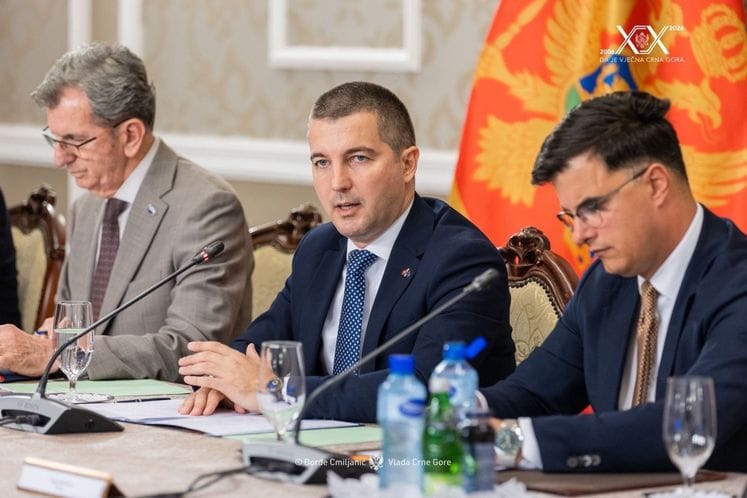
Deputy Prime Minister Aleksa Bečić today opened the roundtable entitled “The voter register – Montenegro’s electoral integrity”, describing it as a representative and credible forum bringing together representatives of the legislative and executive branches, international institutions, civil society organisations, academia and the media, with the aim of fostering a fact-based dialogue on one of the most important issues in the electoral process.
At the beginning of his remarks, Bečić expressed his appreciation to the Working Group for the oversight of the voter register for more than a year of dedicated and committed work, noting that its analyses, findings and recommendations represent an important contribution to the further improvement of Montenegro’s electoral process.
Speaking about the importance of the voter register, Bečić stressed that democratic and free elections are the foundation of every democratic society. He recalled that Article 2 of the Constitution of Montenegro serves as a guiding principle for all political and social actors, and underlined that a credible electoral process and free and democratic elections are a shared objective of all responsible stakeholders, since the legislative and executive branches derive their legitimacy from the freely expressed will of the citizens.
He said that, in his view, the two key pillars of a credible electoral process are freedom – freedom of political participation, expression, political activity and voting – and a voter register that is accurate, orderly and reliable.
Reflecting on democratic developments in Montenegro, Bečić stated that the country had made significant democratic progress since 30 August 2020. He said that one of the greatest achievements of that period had been the strengthening of political freedoms and that recent electoral processes had, by general assessment, represented genuine celebrations of democracy and increasingly resembled electoral processes in the most developed European countries.
Addressing the challenges that remain, he noted that many of them stem from legacy issues and certain legislative limitations that have slowed efforts to achieve a fully updated and reliable voter register.
Bečić paid particular attention to experiences at the local level, citing the case of the Municipality of Šavnik. He said that the findings of the Working Group and the activities of competent institutions had highlighted the consequences of electoral engineering and demonstrated the need for stronger mechanisms for monitoring residence registration.
He explained that these challenges are being addressed through two key courses of action. The first relates to the decision of the Parliament of Montenegro to introduce the holding of local elections on a single day through amendments to the electoral legislation, which he said would significantly reduce both the opportunity and motivation for electoral manipulation. The second concerns further improvements to the legislative and institutional framework governing field inspections conducted by the Police Directorate in cases involving suspected unlawful changes of residence.
Presenting some of the Working Group’s findings, Bečić pointed out that at the time of the population census, the number of registered voters exceeded the number of adult citizens residing in Montenegro by more than 48,000. He noted that this figure almost entirely corresponds to the number of individuals who failed to fulfil their legal obligation to replace their identity cards, including more than 10,000 people who had not replaced their identity cards even during the previous replacement process in 2008.
He said that such conduct is contrary to the Law on Identity Cards and the Law on Residence and Temporary Residence Registers, as well as to the legal definition of residence itself. According to Bečić, these findings provide important guidance regarding the direction of future reforms.
He stressed that discussions on improving the voter register should not be interpreted as being directed against any individual or group, but solely as an effort to bring the register into full compliance with the Constitution and the laws of Montenegro.
Bečić argued that there is an inconsistency within the current legal framework, whereby citizens temporarily residing abroad for more than 90 days are required to report that fact, while citizens who permanently relocate abroad and establish their centre of life elsewhere are not required to deregister their residence in Montenegro. He said that maintaining an accurate and reliable voter register is difficult without updated residence records and a legal obligation to deregister residence when permanently leaving the country.
He further emphasised that deregistering residence has no connection with the loss of Montenegrin citizenship. He described the diaspora as a major strength and valuable asset for Montenegro and stated that no one intends to link residence status with citizenship rights.
Bečić also highlighted the importance of expanding field inspections. He said that such inspections should not be limited to cases involving changes of residence between municipalities within Montenegro, but should apply whenever competent authorities have grounds to question the accuracy of information contained in official records. According to him, citizens who comply with the law have nothing to fear from such inspections. He identified three key measures for addressing voter register challenges: introducing a legal obligation to deregister residence when permanently moving abroad, expanding field inspections to cover all cases of suspected irregularities, and resolving the status of thousands of individuals who have not replaced their identity cards for decades.
The Deputy Prime Minister also referred to broader electoral reform ideas that have already been implemented in certain countries, including voter identification through fingerprints, video monitoring of specific stages of polling station operations while fully preserving ballot secrecy, and the inclusion of voter photographs in electoral records.
He said that all of these issues merit discussion within the broader context of electoral legislation, but reiterated that the three measures related directly to the voter register remain the most important for achieving a credible and reliable electoral system.
Concluding his remarks, Bečić called for continued dialogue and the organisation of similar forums aimed at strengthening public trust in the electoral process and democratic institutions. He stressed that dialogue is the foundation of democratic progress and that all stakeholders should be prepared to assume responsibility for the positions they advocate.
Speaking about the Working Group for the oversight of the voter register, Minister of the Interior Danilo Šaranović said that the Group’s objectives, tasks, analyses and conclusions had fully justified its establishment.
Šaranović noted that official records contain several thousand individuals who have not replaced their identity cards for many years, and in some cases for decades, and who are registered solely on the basis of passports. He added that an analysis of registered voters by residential address revealed a significant level of outdated information in the address registry, as well as a large number of citizens for whom the state does not possess accurate information regarding their actual place of residence.
He further stated that the analysis had identified deceased individuals who remain listed in the voter register, as well as persons born in the early twentieth century who continue to appear in official records, underscoring the need for comprehensive updating and cleansing of the databases.
Šaranović concluded that these issues constitute a series of serious challenges requiring coordinated institutional and systemic action in order to ensure the full integrity of Montenegro’s voter register.
