
- Home
Ibrahimović at MED9+ meeting: Coordinated action n...
Ibrahimović at MED9+ meeting: Coordinated action needed to strengthen supply chain resilience

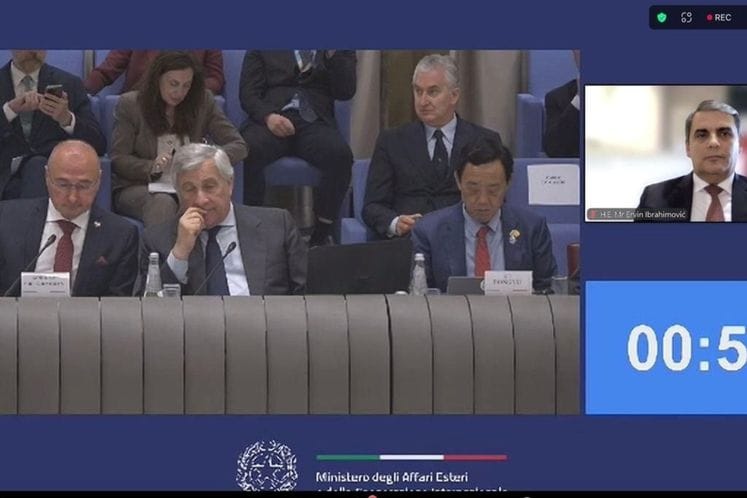
Deputy Prime Minister and Minister of Foreign Affairs Ervin Ibrahimović participated in the VTC ministerial meeting of the MED9+ group, sponsored by foreign ministers of Croatia and Italy, Gordan Grlić-Radman and Antonio Tajani, and Director-General of the Food and Agriculture Organisation of the United Nations (FAO) Qu Dongyu.
The meeting brought together foreign ministers of the MED9 countries, representatives of the Arab League and the Western Balkan countries, as well as officials from international organisations. Discussions focused on the challenges of global food security, supply chains and strengthening regional cooperation amid the current geopolitical circumstances.
In his address, Minister Ibrahimović emphasised that Russia’s aggression against Ukraine, growing instability in the Middle East and disruptions to key maritime routes have significantly affected the global food market, further highlighting the vulnerability of existing food systems.
Ibrahimović stressed that the Mediterranean represents a key hub for trade routes, energy flows and food supply chains, which is why, as he noted, enhancing cooperation in the areas of logistics, transport routes and supply chain resilience is of common interest to all countries in the region.
He said that it is particularly important to improve links between diplomacy, financial instruments and logistical cooperation in order to prevent food insecurity from leading to additional instability and increased migratory pressures, which represent a sensitive issue for the Mediterranean region.
Concluding his remarks, Ibrahimović stated that the MED9+ has the potential to further strengthen the Mediterranean as a space of cooperation, dialogue and shared responsibility, as well as to contribute to shaping a more inclusive and coherent European approach linking food security, foreign policy, and the stability of neighbouring regions.
The meeting participants jointly highlighted the need for stronger international coordination aimed at preserving the stability of global food and fertilizer supply chains, with particular focus on supporting the most vulnerable countries and mitigating the humanitarian, economic and social consequences of the escalating crisis in the Middle East.