
- Home
Ministry of European Affairs Montenegro at the 11th Annual EUSAIR Forum in Skop...
Montenegro at the 11th Annual EUSAIR Forum in Skopje: Commitment to Regional Cooperation Reaffirmed

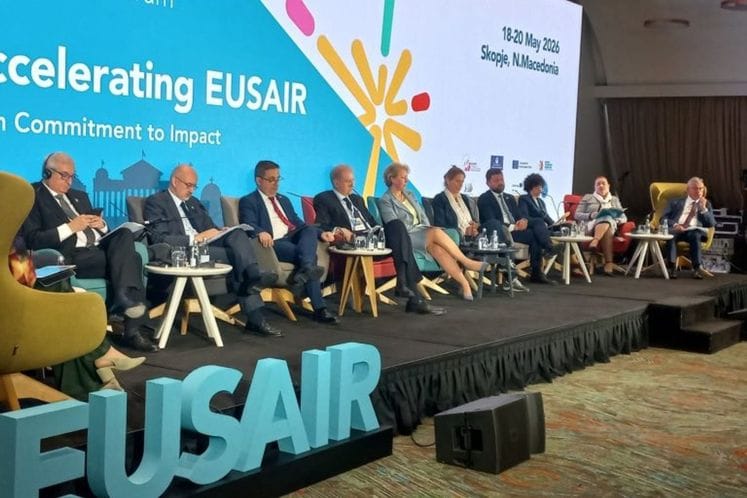
As part of North Macedonia’s presidency of the European Union Strategy for the Adriatic-Ionian Region (EUSAIR), the 11th annual forum is being held in Skopje from May 18 to 20, 2026, under the slogan “From Commitment to Impact.”
The forum brought together high-level representatives of EUSAIR member states, the European Commission, regional and local partners, as well as representatives of civil society, with a special focus on issues related to the European Union enlargement process, encouraging greater youth participation, addressing demographic challenges, and improving cross-border cooperation and regional integration.
The forum also marks the successful conclusion of North Macedonia’s presidency and reaffirms the shared commitment of all participants to achieving the goals of the European Union Strategy for the Adriatic-Ionian Region.

The official opening of the forum took place on May 19 with a high-level panel, where Montenegro was represented by Ivan Ivanišević, Acting Director General of the Directorate General for the European Union at the Ministry of Foreign Affairs and EUSAIR National Coordinator. The official opening was preceded by a ministerial meeting, at which the ministerial declaration was adopted. Representing the Ministry of European Affairs at this meeting, in the capacity of EUSAIR National Coordinator, was Miloš Marković, Director General of the Directorate for European Territorial Cooperation.
By adopting the Skopje Declaration, the participating countries reaffirmed their shared commitment to the European Union enlargement process as a strategic priority, strengthening regional cooperation, and further developing the Adriatic-Ionian region through coordinated action within EUSAIR. The declaration emphasizes the importance of the European Union’s enlargement policy, strengthening the region’s resilience to current geopolitical challenges, as well as improving connectivity, sustainable development, energy security, and the more active involvement of young people and civil society in regional processes.
During the first official day of the Forum, a handover ceremony was held, during which Italy assumed the one-year presidency of the Strategy from North Macedonia.
This three-day event served as a platform for exchanging knowledge, ideas, and examples of good practice, as well as for strengthening cooperation among partners in the Adriatic-Ionian region in addressing common challenges. As part of the Forum, a joint meeting of the national coordinators of the Adriatic-Ionian Strategy and the EU Strategy for the Danube Region (EUSDR) was also held, with the aim of creating a mechanism for cooperation and joint action, as well as strengthening the framework supporting European Union enlargement and regional connectivity among participating countries.

The Forum also featured panel discussions covering relevant topics related to energy challenges in the Adriatic-Ionian region, the importance of the sustainable use and valorization of local natural resources through stronger socio-economic development, the improvement of sustainable urban mobility in cities across the Adriatic-Ionian region through the exchange of good practices, as well as the development of modern and environmentally friendly transport systems.
EUSAIR is based on cooperation, on an equal footing, among ten participating countries: four EU member states — Croatia, Greece, Italy, and Slovenia — and six non-EU countries — Albania, Bosnia and Herzegovina, Montenegro, North Macedonia, San Marino, and Serbia. The aim of the Strategy is to strengthen cooperation and sustainable development in the Adriatic-Ionian region through connecting the countries of the region, protecting the environment, and encouraging economic and social progress.
This forum reaffirmed the continuous commitment of the participating countries to strengthening regional cooperation and advancing the European perspective of the Adriatic-Ionian region.