
- Home
National Council for Sustainable Development holds...
National Council for Sustainable Development holds a session: Joint effort of the Government and the UN

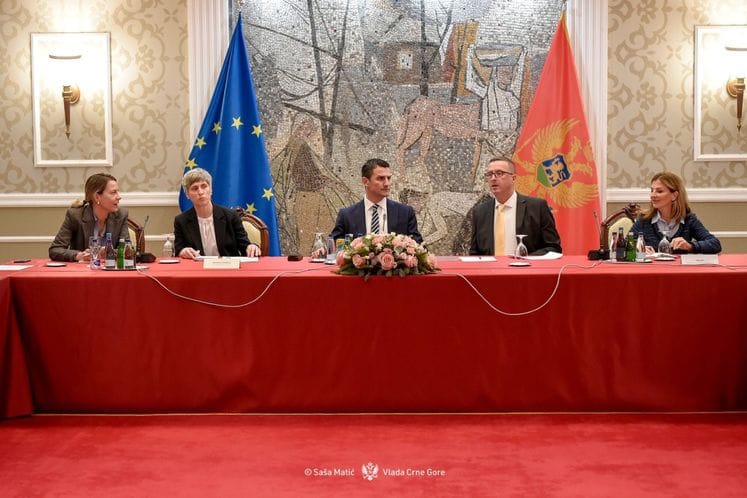
The constitutive session of the National Council for Sustainable Development, Climate Change and Integrated Coastal Zone Management was held today at Villa Gorica chaired by Deputy Prime Minister for Infrastructure and Regional Development Milun Zogović. The session was also attended by UNDP Resident Representative Ekaterina Paniklova.
At the session, Minister of Ecology, Sustainable Development and Northern Region Development Damjan Ćulafić was appointed Deputy Chair of the Council, and the Rules of Procedure were adopted.
The Chair of the Council emphasized that the establishment of the National Council for Sustainable Development, Climate Change and Integrated Coastal Zone Management ensures continuity in the joint efforts of the Government, local governments, academia, the business community, trade unions, the NGO sector, and other stakeholders in building a society rooted in sustainability, solidarity, and responsibility towards future generations. He recalled that Montenegro institutionalized the Sustainable Development Goals in 2016 by adopting the National Strategy for Sustainable Development 2030, and underlined that the Council will continue to serve as a platform for dialogue on key issues.
Zogović expressed his gratitude to the United Nations for their continuous support and partnership in implementing projects that strengthen local communities and institutional capacities. He stressed that the Sustainable Development Goals align with Montenegro’s EU accession priorities, providing an opportunity to improve standards in environmental protection, energy transition, social inclusion, and good governance.
UNDP Resident Representative Ekaterina Paniklova welcomed the renewed establishment of the Council for Sustainable Development and congratulated the new members and the Government on reinstating this important body, extending her appreciation to Deputy Prime Minister Zogović for convening its first session.
Paniklova emphasized that the 2030 Agenda requires joint work and partnership for the benefit of all citizens of Montenegro, as no one should be left behind – one of the central principles of sustainable development. The re-establishment of the Council carries strategic importance for coordinating sustainable development policies, integrating the 2030 Agenda into national strategies, and ensuring coherence across sectors and different levels of government. The Council brings together representatives of the government, civil society, academia, and the private sector, promotes inclusive decision-making, and ensures that diverse voices – including those of young people – are heard.
Paniklova expressed hope that the Council will take on a proactive role through policy harmonization, providing expert advice to the Government, encouraging development financing, building partnerships, and supporting research and innovation. She stressed that the 2030 Agenda is compatible with the EU accession process, while also going beyond the EU acquis, and that Montenegro’s priorities are reflected in the Joint Cooperation Programme valid until 2027. The United Nations remains a reliable partner to the Government on its path toward achieving the Sustainable Development Goals.
