

- Home
Press release from the 128th Cabinet session
Press release from the 128th Cabinet session

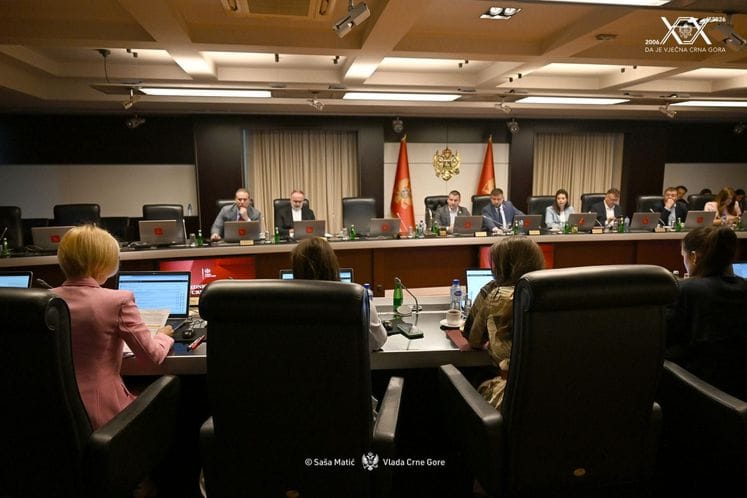
At its 128th session held today and chaired by Deputy Prime Minister for Security, Defence, Fight against Crime and Internal Policy Aleksa Bečić, the Montenegrin Cabinet adopted the Proposal for the Law on Amendments to the Civil Procedure Act.
The amendments to the Civil Procedure Act were introduced with the aim of harmonising the national legislation with Regulation (EU) 2020/1783 of the European Parliament and of the Council of 25 November 2020 on cooperation between the courts of the Member States in the taking of evidence in civil or commercial matters, and Regulation (EU) 2020/1784 of the European Parliament and of the Council of 25 November 2020 on the service in the Member States of judicial and extrajudicial documents in civil or commercial matters. The amendments also ensure alignment with the Law on Life Partnership of Persons of the same sex and improve certain legal solutions in order to eliminate ambiguities identified in practical application.
The Cabinet adopted the Proposal for the Law on Chemicals, further aligning Montenegro’s legislation with the acquis communautaire of the European Union in the field of chemicals management. This law improves the legal and institutional framework, removes technical barriers to trade and strengthens the free movement of goods within the EU single market. Particular emphasis is placed on achieving a higher level of protection of human health, the environment and consumer safety from the harmful effects of chemicals. The legislation introduces modern management mechanisms in line with key European regulations, including REACH and CLP, enabling more efficient control of hazardous substances and encouraging their substitution with safer alternatives. It also provides for the establishment of appropriate databases and the enhancement of the rapid response system of health services in cases of chemical poisoning.
The Cabinet also adopted the Proposal for the Law on Protection against Environmental Noise. This law prescribes measures aimed at avoiding, preventing or reducing the harmful effects of environmental noise, including disturbance caused by exposure to environmental noise, as well as other issues of importance for the protection of the environment and human health from the impact of noise. The adoption of the new law is also necessary in order to clearly and precisely define inspection oversight. Accordingly, the law establishes the competences of local authorities for supervision in this area and ensures the harmonisation of regulations concerning the competences of the communal police and communal inspection services, while also specifying the competences of market and environmental inspectors.
The Cabinet adopted the Regulation on the Conditions for Acquiring Ranks and Rank Levels of Employees in the Administration for the Execution of Criminal Sanctions. During the discussion, it was emphasized that this regulation aligns the existing ranks of employees in the Administration for the Execution of Criminal Sanctions with the Law on the Execution of Prison Sentences, Fines, and Security Measures, and establishes the conditions for acquiring ranks and rank levels of newly created positions, including their coefficients for specific jobs within the Administration, taking into account the specificity, complexity, and security risks of the tasks performed by the employees. These are tasks that, by their nature and degree of responsibility, significantly differ from general civil service duties, which until now were covered by the Law on Civil Servants and Employees, although they objectively required a special regulatory approach. By introducing clearly defined ranks and rank levels, along with the determination of coefficients, a higher level of professionalization is ensured, responsibilities are clearly delineated, a transparent career progression structure is established, and the rights of employees are applied consistently in accordance with education, experience, and professional competence.
The Cabinet also adopted the Regulation on Reimbursement of Costs in the Procedure for Access to Information. This regulation establishes the necessary normative framework for more cost-effective exercise of the right to free access to information, reducing costs for users and thereby contributing to more transparent operations of public authorities, while promoting efficiency, accountability, integrity, and legitimacy of public institutions.
Furthermore, the Cabinet adopted information on agreements concerning the adoption of spatial and urban planning documents for the municipalities of Žabljak and Berane. According to Article 49 of the Spatial Planning Law, local planning documents are adopted by the assembly of the local self-government unit. However, exceptionally, the Government may adopt a local planning document in three cases, one of which is if an agreement is reached with the local self-government unit. In these cases, the local planning document is adopted in the manner and procedure prescribed by the law for a national planning document. These planning documents will be prepared by the Agency for Spatial Planning of Montenegro, and the financial resources for their preparation will be provided by the Municipality of Žabljak – EUR 243,000 and the Municipality of Berane – EUR 230,000.
The Cabinet adopted the Strategy for the Protection of the Marine Environment until 2036. The Strategy was prepared in accordance with the Law on Marine Environment Protection, which transposes the provisions of the Marine Strategy Framework Directive (2008/56/EC) into national legislation, and represents a key strategic document for the management of Montenegro’s marine ecosystem. Through this document, Montenegro establishes an integrated marine environment management system, with the clear objective of achieving and maintaining good environmental status of the marine environment, while ensuring the sustainable use of marine resources and the protection of biodiversity. The Strategy integrates all key elements of marine environment management – from the initial assessment of the state of the marine environment and the definition of objectives and indicators, through the monitoring system, to concrete measures aimed at reducing pressures on the marine ecosystem. The document is fully aligned with the acquis communautaire of the European Union in the field of environment and represents an important instrument in the EU accession process, particularly within Chapter 27.
The Cabinet adopted the Regulation Amending the Regulation on Projects Subject to Environmental Impact Assessment. The Regulation introduces relevant amendments to List II, namely in the part relating to projects for which the preparation of an environmental impact assessment report may be required through the preliminary assessment procedure – the screening phase. In this regard, projects in the field of renewable energy production are added, while exemptions and simplifications of the environmental impact assessment procedure are introduced for certain projects, particularly solar installations on existing structures. In this way, the regulatory framework is aligned with modern European Union standards in the field of energy transition, while maintaining a high level of environmental protection. This Regulation further aligns national legislation with Directive (EU) 2023/2413 of the European Parliament and of the Council (RED III Directive), thereby fulfilling obligations arising from the European Union accession process, particularly within Negotiating Chapter 15 – Energy.
The Cabinet also adopted the Regulation on Materials and Articles Intended to Come into Contact with Food. This Regulation ensures the implementation of the Food Safety Law and full alignment with the acquis communautaire of the European Union in the field of materials and articles intended to come into contact with food.
The Cabinet adopted the Regulation on Food Hygiene. This Regulation prescribes general and specific food hygiene requirements for food business operators, including requirements relating to facilities, premises, equipment, water and energy supply, waste disposal, heat treatment, packaging and wrapping, personal hygiene, employee training, and transport throughout all stages of food production, processing and distribution, including primary food production and related activities. The Regulation enables the implementation of the Food Safety Law and ensures full alignment with the acquis communautaire of the European Union in this field.
The Cabinet adopted the Information on the Need for the Payment of Outstanding Funds for 2025 in the total amount of EUR 1,883,141.96, relating to the following measures: 1.1.2 – Support for the Development of Market-Oriented Milk Production; 2.1.12 – Support for Strengthening the Milk Collection Network; 3.2 – Livestock Improvement Programme; and 4.1 – Old-Age Allowances and Agricultural Insurance Programme.
The Cabinet adopted the Infrastructure Investment Master Plan 2026–2030. During the discussion, it was emphasised that the document represents a strategic framework aimed at: defining priority public infrastructure investments; consolidating existing project lists in order to increase transparency and efficiency; improving the project selection and management system; ensuring alignment with the medium-term budgetary framework and fiscal sustainability through strategic redirection towards capital projects; and strengthening administrative and institutional capacities. The objective of the Master Plan is to accelerate economic growth and improve the quality of life of the citizens of Montenegro through enhanced management of public investments. The key sectors of public infrastructure investments covered by the Master Plan are transport, energy, education, healthcare, environmental protection and communal infrastructure, as well as local infrastructure. The Master Plan includes infrastructure projects with a total estimated value of EUR 5.74 billion. The planned value of implementation of these public infrastructure investments in the period from 2026 to 2030 amounts to approximately EUR 4.7 billion, including all sources of financing. The average annual investment until the end of 2030 is estimated at around EUR 939.6 million, or approximately 11% of GDP. In addition, the Master Plan includes an estimate of potential expenditure amounting to around EUR 638 million for the commencement of implementation of potential new projects by 2030. These are projects that have not yet reached financial closure, and most of them may commence after 2028, when they could have an impact on economic growth.
The Cabinet adopted the Information on the Design and Construction of the New Clinical Centre of Montenegro in Podgorica, together with the Proposal for the Design and Construction Contract. In accordance with the Agreement between the Government of Montenegro and the Government of the French Republic on the implementation of priority projects and financial cooperation in Montenegro, and following the completion of all necessary procedures, the Cabinet approved the text of the Contract to be concluded with the company Bouygues Bâtiment International, which meets the established technical, professional and financial criteria for the implementation of the project.
