
- Home
Press release from the 130th Cabinet session
Press release from the 130th Cabinet session

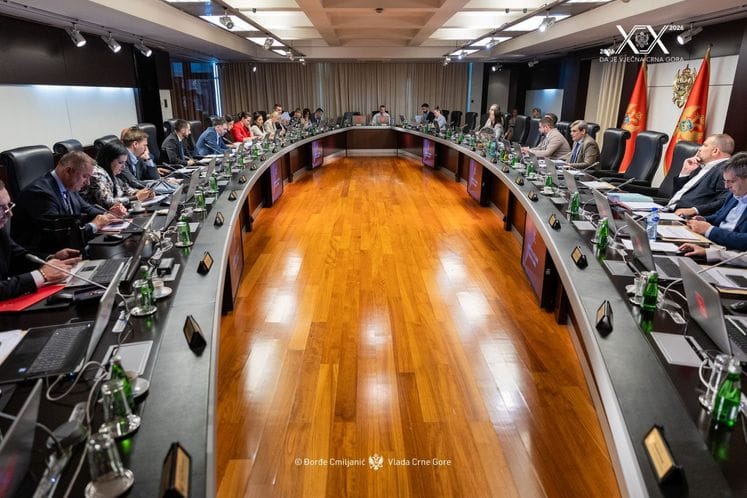
The Montenegrin Cabinet held its 130th session, chaired by Prime Minister Milojko Spajić.
The Cabinet adopted the Draft Law on amendments to the Law on Notaries. During the discussion, it was emphasized that the reason for adopting this law is its alignment with the Law on same-sex life partnership, with the aim of creating conditions for the exercise of the rights of partners in same-sex life partnerships.
The Cabinet adopted the Draft Law on electronic identification and trust services. The main objective of this law is to regulate and ensure the proper functioning of the field of electronic identification and trust services in Montenegro, including their cross-border availability and use. The draft law will build on and further develop investments already made in existing electronic identification and trust service systems, thereby generating a greater positive impact on businesses, public administration, and society as a whole. The existing framework for electronic identification has been expanded and enhanced through the introduction of requirements for digital identity wallets. The implementation of the proposed legislation will enable citizens and businesses to conduct secure electronic transactions based on trust. Specifically, the security and control mechanisms provided under this law are intended to give citizens full confidence that they will have control over who can access their data and which data may be accessed. The proposal also lays down rules governing electronic signatures, electronic seals, electronic time stamps, electronic documents, electronic registered delivery services, website authentication certificate services, remote electronic signature creation devices and remote electronic seal creation devices, electronic archiving, and electronic attestation of attributes.
The Cabinet adopted the Decree on quick-frozen foodstuffs intended for human consumption, with the aim of ensuring the implementation of the Law on Food Safety and achieving full alignment of national legislation with the European Union acquis in this area.
The Cabinet adopted the Decision amending the Decision on the introduction of international restrictive measures established by decisions of the Council of the European Union and regulations of the European Union in relation to the situation in the Republic of Belarus and the involvement of the Republic of Belarus in the Russian Federation’s aggression against Ukraine. During the discussion, it was noted that these amendments form part of the twentieth package of restrictive measures adopted by the Council of the European Union on 23 April 2026, aimed at increasing pressure on the Russian Federation in order to stop its aggression against Ukraine.
The Cabinet adopted the Decision on the establishment of the Coordination Body for monitoring and enhancing cooperation with the International Organisation of La Francophonie (OIF). Recognising the importance of the OIF as a platform for political dialogue, educational, cultural, and economic cooperation, as well as its role in promoting democratic values, human rights, and sustainable development, the need was identified to further strengthen Montenegro’s institutional capacities in this field. The Coordination Body is intended to ensure effective coordination of activities, enhance interinstitutional cooperation, and define strategic guidelines for Montenegro’s engagement within the Francophonie framework, including activities aimed at advancing its status within the OIF. Through its work, the Body will contribute to better preparation and implementation of joint initiatives, improved utilisation of opportunities provided by the OIF in the fields of education, youth mobility, and professional development, as well as more visible promotion of Francophone activities at both the national and international levels.
The Cabinet adopted the Information on the achieved share of energy from renewable sources in gross final energy consumption, as well as the Report on the achieved share of energy from renewable sources in gross final energy consumption in Montenegro for the period 2023–2024. As a member of the Energy Community, Montenegro is obliged to align its national legislation with the European Union acquis in the field of renewable energy sources, with the aim of promoting their increased use and achieving established energy and climate targets. According to the Report, the overall share of energy from renewable sources in gross final energy consumption amounted to 41.70% in 2023, while in 2024 it stood at 41.02%. Given that, in accordance with the obligations arising from Directive (EU) 2018/2001 on the promotion of the use of energy from renewable sources, Montenegro has been assigned a target of reaching a 50% share of renewable energy in gross final energy consumption by 2030, it is necessary to continue activities aimed at promoting renewable energy sources.
The Cabinet adopted the Report on the implementation of international development cooperation and the provision of international humanitarian assistance for 2025. During the discussion, it was emphasized that Montenegro’s current position within the system of international development cooperation and humanitarian assistance has a dual dimension. On the one hand, Montenegro is a recipient of development assistance, thanks to which it has achieved significant progress over the past two decades. On the other hand, it is increasingly assuming the role of a donor, representing a natural continuation of its development and confirmation of the country’s European orientation. The Report states that Montenegro continued in 2025 to contribute to the achievement of international development cooperation goals and the provision of humanitarian assistance through the activities of state institutions and other relevant stakeholders. The total amount recognised as official development assistance amounted to EUR 1,248,800, implemented through humanitarian aid, development cooperation programmes, technical assistance and knowledge transfer, as well as through membership fees and voluntary contributions to international organisations.
The Cabinet adopted the Decree on maximum permitted levels of contaminants in food in order to ensure the effective implementation of the Law on Food Safety and alignment with the EU acquis in this area. The adoption of this regulation is one of the conditions for closing negotiations under Chapter 12 – Food Safety, Veterinary and Phytosanitary Policy.
The Cabinet adopted the Information on the introduction of the undergraduate academic study programme special education and rehabilitation (180 ECTS) and the Master’s academic study programme special education and rehabilitation (120 ECTS) at the Faculty of Philosophy, Nikšić, University of Montenegro.
The Cabinet adopted the Information on the need to procure two multi-purpose aircraft and two multi-purpose helicopters for firefighting, medical evacuation, search and rescue operations, for the operational needs of the Police Directorate, including strategic transport and passenger transport. The Information states that the existing helicopter resources within the Directorate for Protection and Rescue do not provide sufficient capacity for the effective suppression of large-scale fires, particularly in the context of climate change, which is resulting in increasingly frequent and intense wildfire seasons. The procurement of two multi-purpose helicopters would ensure more stable operational readiness, reduce dependence on an ageing fleet, and enable the uninterrupted performance of search and rescue operations, medical evacuations, firefighting missions, flights in support of the Police Directorate, transportation of rescue and emergency response teams, assistance to the population in emergency situations, and support to other state authorities. In addition, the Information notes the necessity of procuring aircraft that, alongside helicopters, would constitute a key component of the aerial segment of the protection and rescue system. The acquisition of such aircraft would systematically strengthen capacities for responding to natural and other disasters, particularly wildfires. It would also enable rapid medical evacuation, thereby improving the national emergency medical assistance system, while simultaneously reducing dependence on regional assistance mechanisms during wildfire seasons and ensuring a greater sovereign response capability. This procurement would further contribute to strengthening the strategic mobility of the Armed Forces of Montenegro, one of NATO’s key capability targets, by enabling the rapid transport of military units and equipment within international missions and operations, as well as for civil protection purposes in emergency situations. To this end, the competent ministries and other relevant institutions have been tasked, through interdepartmental working groups, with conducting market research and submitting a proposal for the most favourable offer for the procurement of the aforementioned aircraft and helicopters.
