

- Home
Press release from the 135th Cabinet session
Press release from the 135th Cabinet session

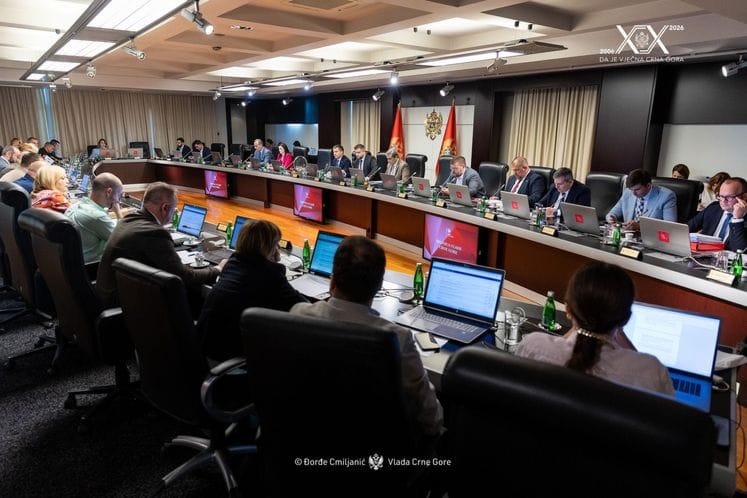
The Montenegrin Cabinet held its 135th session, chaired by Deputy Prime Minister for Security, Defence, Fight against Crime and Internal Policy Aleksa Bečić. The Cabinet adopted the Macroeconomic and Fiscal Policy Guidelines for the period 2026–2029. Given the 44th Government’s commitment for Montenegro to become a full member of the European Union by 2028, with all chapters provisionally closed by the end of 2026, it was emphasised during the discussion that the European agenda is no longer solely a foreign policy objective, but has become the central framework of economic policy and the strongest individual driver of growth, investment and institutional reforms. The credibility of the medium-term framework is based on achieved results, which demonstrate that the Montenegrin economy recorded strong performance in 2025. With GDP growth of 2.7%, the economy grew in all quarters at or above the European Union average, accompanied by an 11.0% increase in fixed capital investment and continued real convergence – GDP per capita has almost doubled over the past five years. The registered unemployment rate became single-digit for the first time and stood at 7.84% in May 2026, the lowest level since the restoration of independence, while the average net salary reached EUR 1,012, representing real growth of around 40% over five years. These indicators place Montenegro among the most dynamic economies compared with both the region and the European Union.
Under the Guidelines for Macroeconomic and Fiscal Policy, based on the baseline macroeconomic scenario, the Montenegrin economy is projected to grow at an average annual rate of 3.1% over the medium term – 3.1% in 2026, 3.0% in 2027, 3.2% in 2028 and 3.1% in 2029. Inflation is expected to gradually decline from 3.3% in 2026 to 2.0% in 2028 and 2029, averaging around 2.4% over the projected period. These trends define the fiscal framework in which public revenues are projected to increase from EUR 3.5768 billion, or 41.6% of GDP in 2026, to EUR 3.9891 billion, or 42.4% of GDP in 2029.
At the same time, the overall state budget expenditure ceiling will range from EUR 3.158 billion, or 36.8% of GDP, in 2026, to EUR 3.4174 billion, or 34.8% of GDP, in 2029. This means that the share of public spending in GDP will continuously decrease, while expenditure will be redirected towards capital investment and areas with the greatest contribution to economic growth, alongside regular pension and social benefit adjustments and stronger financing of the healthcare system.
As a result, the budget deficit is projected to gradually decline from 3.7% of GDP in 2026 to 3.2% of GDP in 2029, while the primary deficit will decrease from 1.7% to 0.6% of GDP. The deficit is entirely generated by financing capital and development projects. A current budget surplus will be achieved throughout the projected period, increasing from EUR 110.1 million (1.3% of GDP) in 2026 to EUR 214.9 million (2.2% of GDP) in 2029. In other words, the state is not borrowing for consumption, but for assets – infrastructure that permanently increases the country’s economic potential.
The same approach applies to public debt management. The temporary increase in debt to 68.0% of GDP in 2026 is the result of a prudent strategy of pre-financing obligations falling due in 2027, primarily a EUR 750 million Eurobond, and creating a fiscal reserve. This approach reduces refinancing risks and avoids borrowing under unfavourable market conditions. From 2027 onwards, public debt is expected to decline, reaching 59.9% of GDP by the end of 2029, below the fiscal responsibility threshold of 60%. Net public debt is projected at 56.4% of GDP, with a highly stable structure in which 99.7% of debt is denominated in euros, effectively eliminating currency risk.
The Cabinet adopted the Draft National Security Strategy of Montenegro.
With the aim of aligning national legislation with the acquis of the European Union, within the framework of Chapter 12 – Food Safety, Veterinary and Phytosanitary Policy, the Cabinet considered and adopted several acts:
- Regulation on novel foods;
- Regulation amending the Regulation on the conditions, manner and timeline for implementing agricultural policy measures for 2026 – the Agricultural Budget;
- Updated National Programme for Improving the Quality of Raw Milk, with an Action Plan and a Plan for the Management of Non-Compliant Raw Milk;
- Regulation on detailed conditions for derogations concerning requirements arising from food regulations applicable to establishments with small-scale production of products of animal origin;
- Roadmap for national reference laboratories;
- Updated Action Plan for strengthening the administrative capacities of the Food Safety, Veterinary and Phytosanitary Affairs Administration;
- Updated Roadmap for the establishment and improvement of border control posts in Montenegro;
- Regulation on the placing on the market of small quantities of primary products of animal origin produced on farms and intended for human consumption;
- Regulation on the placing on the market of small quantities of products of animal origin intended for human consumption.
The Cabinet also approved the allocation of EUR 200,000 from the Current Budget Reserve for the needs of the Food Safety, Veterinary and Phytosanitary Affairs Administration. Furthermore, it adopted the Information on defining the location of the Veterinary and Phytosanitary Border Inspection Post at the “Ilino Brdo” border crossing with Bosnia and Herzegovina, as well as the Information concerning the conclusion of a Memorandum of Cooperation between the Administration of the Republic of Slovenia for Food Safety, Veterinary Sector and Plant Protection and the Food Safety, Veterinary and Phytosanitary Affairs Administration of Montenegro in the field of management of animal by-products.
The Cabinet adopted the Draft Law on Amendments to the Law on Real Estate Transfer Tax. The amendments envisage extending the existing tax rights and exemptions currently available to spouses to same-sex life partners, with the aim of harmonising legislation and ensuring equal application of the law.
The Cabinet adopted the Draft Law on Environmental Noise Protection, together with the Report on the public consultation process. The new law establishes measures aimed at avoiding, preventing or reducing the harmful effects of environmental noise, including disturbance caused by exposure to environmental noise, as well as other issues important for protecting the environment and human health. Among other things, the adoption of the new law is necessary to clearly and precisely define inspection supervision. The law establishes the responsibilities of local authorities in this area and ensures alignment of regulations regarding the competences of communal police and communal inspection services, while also defining the responsibilities of market and environmental inspectors. The adoption of this law continues the harmonisation of Montenegro’s legislation with European Union directives and international standards in the field of environmental noise protection, contributing to the fulfilment of obligations under Chapter 27 – Environment and Climate Change.
The Cabinet adopted the Decision on the preparation of the Spatial Plan for the special purpose area of the Coastal Zone of Montenegro. The purpose and objective of this document is to create a planning and formal basis for ensuring sustainable development of the coastal area, which represents one of the most important challenges in spatial planning policy. The planning concept will be based on an integrated and sustainable approach, ensuring that development needs are harmonised with the principles of spatial and environmental protection. Special emphasis will be placed on controlling and directing urban development, improving communal and transport infrastructure, enhancing the quality of life of residents, rational use of land in urban, peri-urban and rural areas. In areas where spatial and urban structures have been disrupted, measures and guidelines for urban regeneration, rehabilitation and improvement of landscape values will be defined. Particular importance will be given to implementing the principles of integrated coastal zone management, by aligning all development activities with spatial protection rules, guidelines and regimes. Special attention will be devoted to protecting the maritime domain, coastal ecosystems, landscape values and natural resources, ensuring a balance between economic development and environmental preservation for future generations. The Plan will be prepared by the Agency for Spatial Planning of Montenegro, while the required funds in the amount of EUR 800,000 will be provided from the state budget.
The Cabinet adopted the Information on the need to introduce a new system for issuing residence and work permits for foreign nationals. The Information highlights that Montenegro’s forthcoming accession to the European Union requires further significant alignment of national legislation with EU directives and regulations concerning the entry, residence and employment of foreign nationals in Montenegro, with the aim of preventing irregular migration, including unlawful residence and undeclared work by foreign nationals. This requires the establishment of a new institutional framework and improved functioning of competent authorities, starting from the issuance of residence and work permits, followed by monitoring the employment of foreign nationals, the exercise of their rights, fulfilment of their obligations, as well as the obligations of employers engaging foreign workers on any basis. Taking into account these circumstances, the Government assessed that the introduction of a single permit system for temporary residence and work would be justified. As before, such permits would be issued by the Ministry of Interior through its regional organisational units, following the completion of the relevant procedure. The novelty would be the requirement to obtain prior approval from the Employment Agency of Montenegro, without which the permit could not be issued. In this regard, the competent ministries have been tasked with jointly considering and proposing the most appropriate legislative model that would define the new system for issuing residence and work permits for foreign nationals, as well as ensuring the interoperability of information systems and data exchange in order to enable the efficient implementation of the new legal framework.
