

- Home
Press release from the 84th Cabinet session
Press release from the 84th Cabinet session

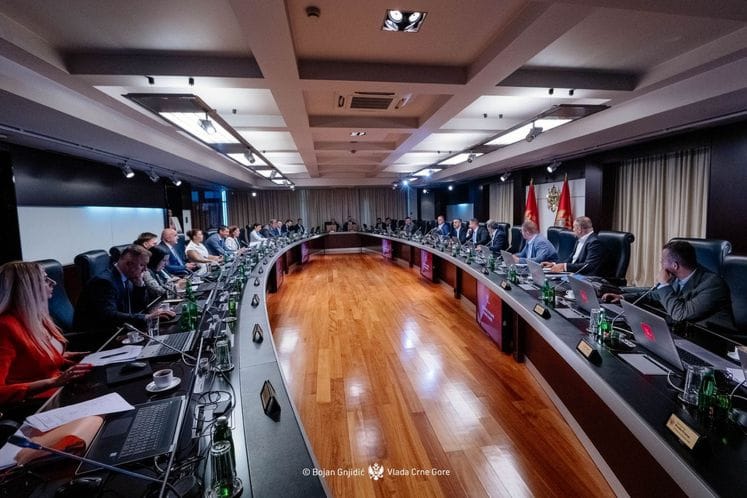
At today's 84th session chaired by Prime Minister Milojko Spajić, the Montenegrin Cabinet endorsed the Proposal for a decision to adopt the Spatial Plan of Montenegro. The Spatial Plan of Montenegro is a strategic planning document within the spatial planning system and a general basis for the organisation and arrangement of space in Montenegro, which determines state goals and measures of spatial development in accordance with the overall economic, social, ecological, and cultural-historical development of Montenegro. This strategic plan outlines the development and the general basis for the organisation, usage, arrangement, and protection of the space of Montenegro for the planning period until 2040.
Out of the total area of the territory of Montenegro (13812 km2), the usage structure measured cartographically is as follows: building area accounts for 3.14% of the territory, with 0.04% of infrastructure areas; agricultural areas, arable and other agricultural land account for 14.94%, while forested areas cover 62.07% of the territory. There is little arable agricultural land, only 3.77%, which indicates the sensitivity of these areas and the need for preservation and sustainable use. In terms of forest coverage, Montenegro is among the most forested countries in the Balkans and in Europe.
The today's session adopted the Regulation on the minimum sum of liability insurance for damages that may arise from activities related to the preparation of planning documents. The Regulation stipulates the minimum sum of liability insurance for a company engaged in the preparation of planning documents, for damages that may occur to investors or third parties in connection with the performance of these activities.
The professional liability insurance amounts to: EUR 200,000 for a company that prepares state planning documents and EUR 150,000 for a company that prepares local planning documents.
The Law on Spatial Planning states that these companies are required to conclude a professional liability insurance contract for damages that may occur to investors or third parties before starting their activities; that the insurance must cover the risk of liability for damages caused to individuals, for damages to properties as well as financial losses, and that the minimum insurance sum must be ensured.
The Cabinet also adopted the Decision amending the "Kalardovo - Island of Flowers - Brdišta" State Location Study. The area of the project covers 200.7 hectares, of which 145.72 hectares is land and 54.98 hectares is marine aquatorium. The main goal and task of the amendments is to reassess the planning solutions, particularly in the area of cultural heritage, based on expert findings, archaeological research, and the Study for the protection of cultural goods that has been carried out, as well as to ensure the conditions for further development of the subject area, while respecting the principles of planning for the protection and use of the space. Through the preparation of the amendments, the planning solution has been reassessed primarily considering the complexity and intricacy of the location, which is situated within the protected environment of the Kotor Area, listed as a UNESCO World Heritage Site, while the peninsula of Prevlaka has the legal status of an immovable cultural property, along with the preservation of the cultural landscape defined by summer residences from the early Middle Ages – Dančulovina and Grgurevna.
The Cabinet session adopted the Information on the proposal for resolving the status of tobacco products seized in accordance with the Decision on the prohibition of storing tobacco products in the territory of the Luka Bar Free Zone. In that context, the Cabinet decided to destroy the seized tobacco products, which, as emphasised, systematically closes the long-standing issue of handling tobacco products seized on this basis, and the Government demonstrates clear and unwavering determination to systematically and uncompromisingly combat the smuggling of tobacco products, which represents a long-term security, fiscal, and economic challenge.
By destroying the seized tobacco products, resources of the relevant authorities currently directed towards intensified monitoring of goods will be freed up. Additionally, the Decision will have a positive impact on businesses that operate legally, as reducing the illegal market will also reduce unfair competition. The destruction of illegal tobacco products sends a clear message that the state will not tolerate violations of the law, thereby strengthening citizens' trust in institutions and the rule of law.