
- Home
Spajić: Goal within reach as Montenegro enters fin...
Spajić: Goal within reach as Montenegro enters final stretch of EU accession negotiations

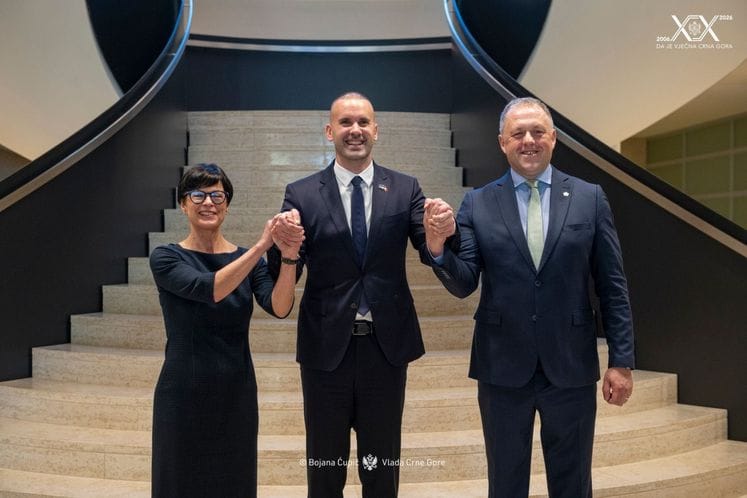
At the 29th Intergovernmental Conference with the European Union, held in Luxembourg, Montenegro provisionally closed three negotiating chapters: Chapter 17 (Economic and Monetary Policy), Chapter 18 (Statistics) and Chapter 19 (Social Policy and Employment). This brings the total number of provisionally closed chapters to 21, marking a record number of chapters closed in a single year since the accession negotiations began.
Addressing the Intergovernmental Conference, Prime Minister Milojko Spajić said that the results achieved confirm that Montenegro’s goal is within reach and that intensive reform efforts, supported by European partners, are delivering tangible progress.
Our ambition is clear: to provisionally close all remaining negotiating chapters by the end of 2026, while simultaneously preparing Chapter 34 and reaching agreement on it as soon as possible, and to move towards signing the Accession Treaty as early as possible in 2027, Spajić said.
The Prime Minister assessed that 2026 had already become a turning point for Montenegro’s accession process and the European Union’s enlargement policy. In this context, he particularly highlighted the establishment of the working party tasked with preparing the Accession Treaty, progress in closing negotiating chapters, and the European Union’s preparations for the admission of new members.
He thanked all EU Member States, the European Commission and expert teams for their support and cooperation, emphasising that the progress achieved was the result of joint efforts by Montenegrin and European institutions, growing mutual trust and a consistent commitment to European standards.
For Montenegro, European integration is a strategic choice for society as a whole and a political commitment. We are implementing decisive reforms because our citizens and businesses deserve stronger institutions, greater economic opportunities, the rule of law and a better quality of life, the Prime Minister said.
Speaking about the closed chapters, Spajić noted that they represent three important pillars of European integration: sound economic governance, reliable data for public policymaking, and social progress.
With regard to Chapter 17, he pointed to efforts to strengthen the independence of the Central Bank, improve the economic and monetary framework, and launch the work of the Fiscal Council. He stressed that the priorities were macroeconomic stability, sustainable convergence with the European economy and the effective implementation of adopted reforms.
The provisional closure of Chapter 18 confirms progress in building a high-quality, reliable and independent statistical system, which serves as the foundation for accountable governance and evidence-based decision-making. In the area of social policy and employment, the Prime Minister highlighted the protection of workers’ rights, stronger social dialogue, equal opportunities and improved access to social services.
We want a competitive economy that creates jobs and attracts investment, with growth accompanied by dignity for workers, fairness and social protection, Spajić said.
He particularly highlighted the intensive work carried out in the area of the rule of law over the previous six months, expressing his expectation that the progress achieved would enable the remaining chapters under the fundamentals cluster to be provisionally closed soon.
The Prime Minister noted that Montenegro had 12 negotiating chapters left to provisionally close and said that the institutions would continue working at full capacity.
Our goal is not merely to conclude the negotiations, but to ensure that Montenegro is ready, from the first day of membership, to assume all obligations and responsibilities and actively contribute to the European Union. We face a historic opportunity that we must seize decisively, with mutual trust and a shared sense of responsibility, Spajić concluded.
