
- Home
Ministry of European Affairs Strengthening Capacities for Harmonizing Legislati...
Strengthening Capacities for Harmonizing Legislation with the European Union Acquis

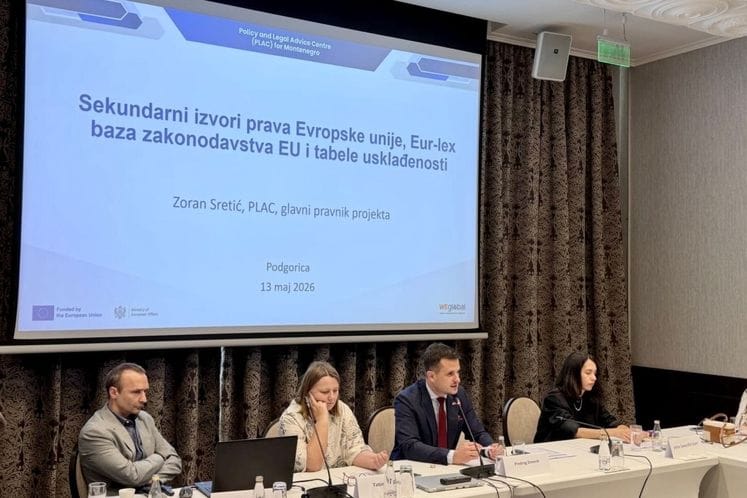
Organized by the Ministry of European Affairs and the project “Strategic-Legal Advisory Centre for Montenegro” (PLAC), a workshop dedicated to strengthening the capacities of the negotiation structure in the field of harmonizing national legislation with the European Union acquis was held today in Podgorica.
The workshop brought together representatives of institutions and members of the negotiation structure with the aim of improving knowledge and practical skills in the process of identifying relevant European Union legislation, preparing tables of concordance, and understanding the legal and technical aspects of translating the EU acquis.
Montenegro’s Chief Negotiator with the European Union, Predrag Zenović, emphasized that the high-quality harmonization of legislation represents one of the key prerequisites for the successful completion of negotiations and Montenegro’s future functioning as a member state of the European Union.
“High-quality harmonization of legislation with the European Union acquis is today one of the most important tasks in the negotiation process. That is why it is especially important for institutions to have the professional capacities for the proper understanding, translation, and implementation of European regulations, because the quality of that process directly determines the quality of Montenegro’s future legal system.”

He stressed that the workshop provides concrete knowledge and practical guidelines that are particularly important in the final phase of negotiations, when the focus is on the quality of legislative alignment and its effective implementation.
PLAC Project Manager Tatjana Tomić stated that the workshop was organized in response to the needs of institutions involved in the negotiation process.
“The topic of the workshop is extremely important for the process of harmonization with the European Union acquis — from identifying relevant regulations and preparing tables of concordance to the professional process of translating EU legislation. It is a demanding process in which high-quality translation represents one of the key prerequisites for the proper implementation of European regulations,” said Tomić.
During the workshop, participants had the opportunity to further improve their knowledge of the legal and technical aspects of the legislative harmonization process through practical examples and discussions with domestic and international experts.
The PLAC project continues to provide expert support to Montenegro’s institutions in the process of European integration, with the aim of strengthening administrative and legal capacities for the effective implementation of reforms and preparation for membership in the European Union.
The workshop was led by Zoran Sretić, Chief Legal Expert of the PLAC project, and Jelena Samardžić Kotri, Head of the Directorate for the Preparation of the Montenegrin Version of the EU Acquis at the Ministry of European Affairs. They presented participants with practical aspects of using the EUR-Lex database, professional legal editing, and the preparation of tables of concordance in the process of harmonizing national legislation with the European Union acquis.
A special segment of the workshop was dedicated to the importance of preparing the Montenegrin version of the EU acquis, as one of the key elements of the negotiation process and Montenegro’s future functioning as a member state of the European Union. It was pointed out that high-quality translation and terminological alignment of European regulations are not merely technical issues, but important prerequisites for the proper understanding, implementation, and enforcement of European legislation within the national legal system.
The lecturers emphasized that the multilingual nature of the European Union acquis requires a high degree of precision and expertise in the translation and editing process, since incorrectly translated or terminologically inconsistent regulations may produce serious legal and practical consequences. It was also highlighted that the preparation of the national version of the acquis represents an important part of the country’s administrative and institutional preparation for European Union membership, particularly in the final phase of negotiations, when the focus shifts to the quality and sustainability of implemented reforms.