
- Home
DPM Koprivica meets with Chief Prosecutor of the I...
DPM Koprivica meets with Chief Prosecutor of the International Residual Mechanism for Criminal Tribunals Serge Brammertz

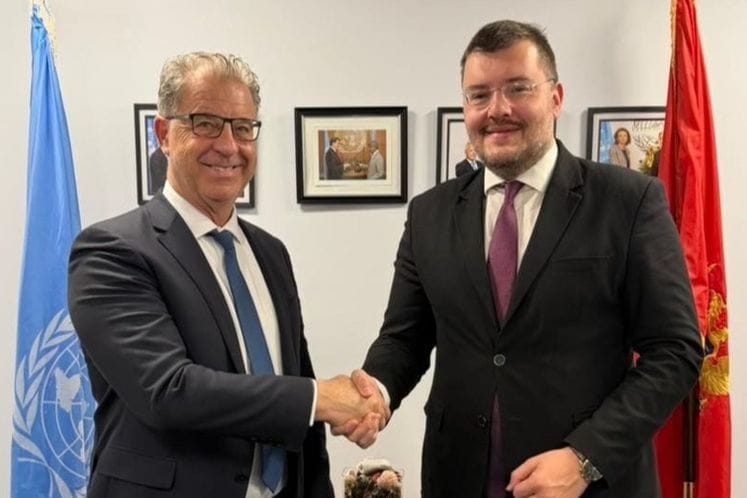
Deputy Prime Minister for Political System, Justice, and Anti-Corruption Momo Koprivica and Chief Prosecutor of the International Residual Mechanism for Criminal Tribunals in The Hague Serge Brammertz held a meeting in New York, during which the progress Montenegro has made in prosecuting war crimes and strengthening the rule of law was assessed.
The meeting highlighted that Montenegro has achieved clear and measurable progress, thanks to strengthened institutional capacities and improvements to judicial mechanisms.
Deputy Prime Minister Koprivica emphasized the Government’s firm commitment to fully supporting the non-selective prosecution of all war crimes and impartial adjudication, regardless of who the perpetrator or victim is, as these are prerequisites for justice and the rule of law. He also emphasized important decisions made by the current Government regarding issues of dealing with the past, which had burdened society for decades and represented an avoidance of state responsibility for long-standing injustices. In this context, he particularly highlighted the introduction of the legal institute of the civilian victim of war, established on the broadest basis in the region, with the aim of publicly acknowledging suffering and providing fairer reparations to the families of those killed in war crimes. In this way, Koprivica noted, Montenegro pursues justice while building an environment where human rights come first and accountability for crimes is imperative. As another important precondition for prosecuting war crimes, Koprivica also underlined the adoption of amendments to the Criminal Procedure Code, proposed by the Government, which enable the transfer of evidence from the Residual Mechanism in The Hague.
Chief Prosecutor Brammertz noted that the report concerning Montenegro represents a positive example and a bright spot in the region, although further progress is still necessary. He emphasized the importance of continuing reforms and further strengthening capacities. He also noted that progress made by Montenegro is recognized both within the United Nations and in Brussels, especially in relation to evidence collection.
The two officials particularly highlighted the recent judgment imposing the maximum sentence for a war crime, as well as the indictment filed against a former police officer for crimes committed during the 1990s. These results confirm the credibility of the work of the Special State Prosecutor’s Office and the overall commitment of the state to ensuring full access to justice and the prosecution of all perpetrators without exception.
In this regard, the effective work of the Special State Prosecutor’s Office was emphasized, as its professionalism, independence, and consistent action provide key contributions to the prosecution of the most serious criminal offenses.
The meeting also assessed as positive the adoption by the Supreme State Prosecutor’s Office of the Strategy for Investigating War Crimes, accompanied by an Action Plan, whose implementation is proceeding with a high rate of success. This strategic framework represents an important tool for improving procedural efficiency, strengthening investigative methodology, and fulfilling Montenegro’s international obligations.
Deputy Prime Minister Koprivica stressed that a proactive approach is essential, particularly considering the significant passage of time since the events of the 1990s. He emphasized that the number of living witnesses and victims who can provide relevant information decreases over time, which further increases the importance of timely and comprehensive action by prosecutorial and police authorities. He noted that he had the opportunity to speak with Veselin Bojović from Žabljak, who is an example of a relevant source of knowledge and evidence and who survived severe suffering in the Lora prison camp. Precisely such cases, he added, demonstrate that both justice and the need for judicial efficiency require proactivity and timeliness. Furthermore, he expressed confidence that recently concluded agreements between Montenegro’s Supreme State Prosecutor’s Office and the prosecutors’ offices of Bosnia and Herzegovina and Serbia, as well as an Annex to the Agreement with the Croatian Prosecutor’s Office establishing full reciprocity in evidence exchange, will contribute to effective and fair prosecution of all war crimes. He also noted expectations that forthcoming guidelines from the Supreme Court and the Supreme State Prosecutor’s Office – aimed at resolving property-legal claims in criminal proceedings, particularly compensation for victims’ non-material damage without referring them to civil litigation – will contribute to justice and efficiency. He expressed full support for this systemically important process.
In conclusion, Deputy Prime Minister Koprivica and Chief Prosecutor Brammertz expressed their shared conviction that Montenegro will continue to strengthen the work of its institutions, enhance regional cooperation, and contribute to a culture of remembrance, justice, and accountability.