
- Home
Press release from the 104th Cabinet session
Press release from the 104th Cabinet session

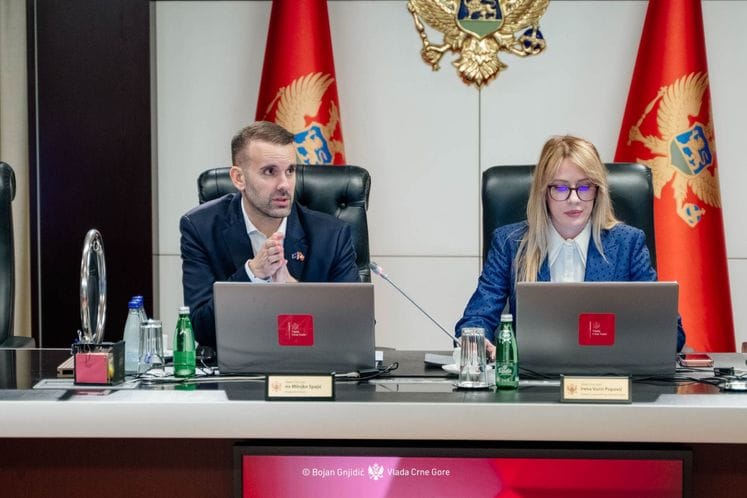
The Montenegrin Cabinet held its 104th session, chaired by Prime Minister Milojko Spajić. The Cabinet adopted the Report on the Implementation of the Work Programme of the Government of Montenegro for the 3rd Quarter of 2025, along with the Report on the Implementation of Government Conclusions for the 2nd Quarter of 2025. Within the planned obligations for the 3rd quarter of 2025, the Programme envisaged a total of 66 activities: 25 under the competence of the Commission for the Political System, Internal and Foreign Policy, and 41 under the competence of the Commission for Economic Policy and the Financial System. Out of the total planned activities, the Government completed 13 within the competence of the Commission for the Political System, Internal and Foreign Policy (6 thematic and 7 normative), and 22 activities within the competence of the Commission for Economic Policy and the Financial System (15 thematic and 7 normative). Thus, the overall implementation rate of the Government Work Programme for the 3rd quarter of 2025 amounts to 53%. During the discussion, it was emphasized that most of the unimplemented obligations are in the final stage of preparation, and that delays are largely the result of additional consultations with relevant domestic and European institutions and civil society representatives, aimed at ensuring full alignment with EU standards and practices. It was noted that most of these obligations will be completed by the end of the year.
According to the Report on the Implementation of Government Conclusions, the Cabinet adopted 256 conclusions in the 2nd quarter of 2025 that are subject to monitoring. Of these: 188 conclusions were implemented, 18 were not implemented, and 50 have not yet reached their deadline. The implementation rate of Government conclusions for the 2nd quarter of 2025 is therefore 91.26%.
The Cabinet adopted the Decision on the Energy Balance of Montenegro for 2026. Under the Energy Law, the Energy Balance consists of the balances of electricity, coal, oil, oil derivatives and biofuels, natural gas, thermal energy for district heating/cooling and industrial use, and wood fuels.
The Energy Balance for 2026 was prepared based on data from: Electric Power Company of Montenegro (EPCG), Montenegrin Electricity Distribution System (CEDIS), Montenegrin Electricity Transmission System (CGES), domestic electricity producers, Coal Mine Pljevlja, and estimated oil derivative volumes provided by oil companies. Ensuring sufficient quantities of all energy sources is a key prerequisite for implementing planned economic and social activities in Montenegro during 2026. All energy stakeholders and competent authorities were urged to fully commit to implementing the measures set out in the Balance.
Regarding electricity, total production in Montenegro in 2026 is planned at 3,798 GWh, which is 57.6% more than the estimated output for 2025. The main reason for the increase is the return to operation of the Thermal Power Plant after its environmental reconstruction and the significant planned increase in solar energy production. This results in a surplus of 398 GWh for 2026. Next year, it is planned to commission the Gvozd Wind Farm with a capacity of 54 MW. EPCG also plans the gradual commissioning of commercial solar power plants, which will reach a combined capacity of about 84 MW by the end of the year. The Solari 5000+ project will continue, providing new capacity that – together with the already completed Solari 3000+/500+ projects – will reach around 105 MW by the end of 2026. Additionally, several commercial solar plants by private investors are in trial operation or under construction, with a total expected capacity of around 25 MW by the end of 2026. If all planned projects are implemented, the installed solar capacity should reach around 215 MW, while the total available generation capacity of all power plants in Montenegro should reach 1,320 MW.
