

- Home
Press release from the 126th Cabinet session
Press release from the 126th Cabinet session

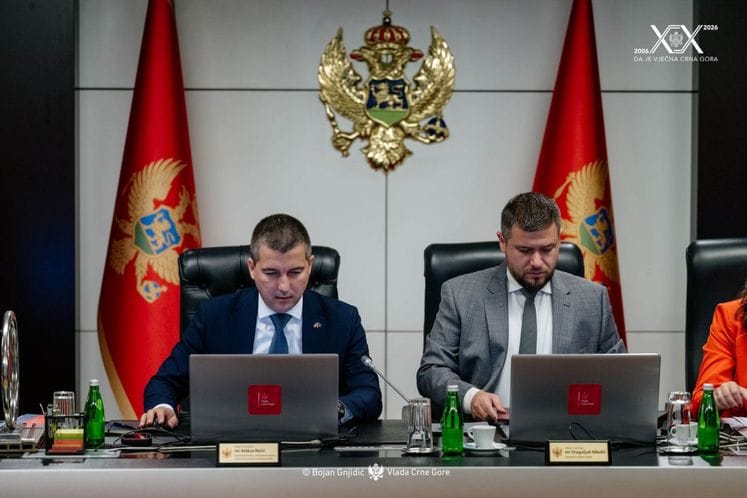
At its 126th session held today, chaired by Deputy Prime Minister for Security, Defence, Fight against Crime and Internal Policy, Mr. Aleksa Bečić, the Montenegrin Cabinet established the Draft Law on Local Self-Government.
During the discussion, it was emphasized that this is one of the most important reform laws in the field of public administration and decentralisation in modern Montenegro. The Draft Law lays the foundations for a new model of state governance – a model in which local self-governments are not merely implementers of decisions made at the central level, but strong development partners, responsible for the quality of life of citizens and capable of independently managing their own potential.
The essence of the reform is reflected in the principle that the state must be closer to its citizens, while local self-government must be more efficient, accountable, and functional. This normative framework is fully aligned with Montenegro’s priorities within the European Union accession negotiations, particularly in the areas of decentralisation, professionalisation of public administration, digitalisation, and strengthening institutional transparency.
The Cabinet also adopted the Decree on the List of Disasters. During the discussion, it was highlighted that the reasons for adopting this decree stem from the need to clearly, precisely, and systematically define phenomena and events considered disasters within the meaning of the Law on Recovery Following a Disaster, in order to ensure legal certainty, uniform application of regulations, and efficient action by competent authorities in damage assessment and post-disaster recovery procedures.
The adoption of this Decree establishes a normative framework that contributes to a more efficient disaster risk management system, the improvement of preventive action, as well as a faster and more organised state response in situations that may have serious consequences for human life and health, property, infrastructure, and the environment.
In this context, the Cabinet also adopted the Decree on the Unified Methodology for the Assessment of Damage, Losses, and Needs Following a Disaster, which establishes a unified and reliable system for assessing damage, losses, and needs after a disaster, with the aim of ensuring more efficient recovery management, fairer allocation of assistance, faster decision-making, and stronger institutional preparedness for responding to disaster situations, in accordance with the Law on Recovery Following a Disaster.
The methodology is aligned with internationally recognised post-disaster assessment frameworks (PDNA – European Commission, United Nations, and the World Bank), thereby enabling assessment results to serve as a basis for the mobilisation of international assistance, while ensuring the consistent application of the national legislative framework.
Furthermore, the Cabinet adopted the Decree on Sectoral Criteria for Determining Critical Infrastructure. The adoption of this Decree ensures the harmonisation of domestic regulations with modern European standards in the field of security and resilience of critical infrastructure.
It also enables the timely identification and protection of facilities and systems whose disruption may have serious consequences for security, economic stability, public health, and the daily lives of the citizens of Montenegro.
The Decree represents an important instrument within the system of national security, civil protection, and crisis management, and contributes to strengthening institutional resilience, risk prevention, and a more efficient response to contemporary security challenges and threats.
The Cabinet adopted the Information on the Agreement on the Adoption of the Spatial and Urban Development Plan of the Municipality of Tivat and accepted the text of the Agreement.
Pursuant to Article 49 of the Law on Spatial Planning, local planning documents are adopted by the assembly of the local self-government unit. However, it is premeditated that, exceptionally, the Government may adopt a local planning document in three cases, one of which is when such adoption is agreed upon with the local self-government unit.
In such cases, the local planning document shall be adopted in the manner and according to the procedure prescribed by this Law for state planning documents.
In this regard, the Municipality of Tivat initiated the adoption of the Spatial and Urban Development Plan of the Municipality of Tivat by the Government, making the conclusion of this Agreement a necessary step.
The Plan will be prepared by the Spatial Planning Agency of Montenegro, while the Municipality of Tivat will provide financial resources for the preparation of the Plan in the amount of EUR 270,000.
The Cabinet adopted the Crisis Plan for Resolving Disruptions in the Supply of Petroleum Products.
The Crisis Plan contains procedures and criteria for determining disruptions in supply, the competences and responsibilities for eliminating supply disruptions, as well as procedures for restoring the normal supply of petroleum products to the market of Montenegro.
The Cabinet accepted the Amendment to the Draft Law on Amendments to the Law on Excise Duties, submitted to the Parliament of Montenegro by Member of Parliament Tonći Janović.
The Amendment proposes a supplement to Article 30 of the Law on Excise Duties, which regulates the right to a refund of paid excise duty.
It also specifies the deadline for submitting requests for excise duty refunds, stipulating that persons entitled to a refund shall submit their request to the customs authority within 30 days from the expiry of the month in which the excise duty was paid.
In this way, greater legal certainty is ensured, along with a more precise application of legal provisions by the customs authority.
The Cabinet adopted the Decision on the Adoption of Amendments to the Urban Development Project “Drač – Fire Station – Zone A” in the Capital City of Podgorica.
The area covered by the amendments to the Urban Development Project, as an important spatial, economic, and social resource of the Capital City, should be developed in a directed and controlled manner, using its created potential in a sustainable way.
The main objective to be achieved is to provide planning preconditions for development and construction through a comprehensive and rational assessment of the significance of the location and the determination of the optimal scope of construction, based on the planning commitments, guidelines, and criteria contained in higher-level planning documentation.
The main amendment to the planning solution compared to the existing Urban Development Project is planned within Urban Block A, specifically the cancellation of the planned public garage beneath the courtyard of the “Savo Pejanović” Primary School and the residential-commercial building at the location along Hercegovačka Street.
The Cabinet adopted the Spatial Planning Programme for 2026.
The Spatial Planning Programme is adopted pursuant to Article 10 of the Law on Spatial Planning and contains an assessment of the need for the preparation of new planning documents, as well as amendments and supplements to existing ones, based on the principles of balanced urbanisation and sustainable spatial development, with priority given to areas that have not yet been covered by detailed planning.
Among other things, the Programme includes: the dynamics of spatial planning; measures of importance for the preparation of planning documents; sources of financing, deadlines, and operational measures for the implementation of planning documents, as well as other measures aimed at implementing spatial planning policy.
The Programme also contains an overview of planning documents currently under preparation, as well as those whose preparation and adoption are planned, in order to align the concept of spatial development with the new system of spatial planning, adapted to Montenegro’s strategic development goals.
The Cabinet adopted the Decree on Amendments to the Decree on Detailed Sustainability Criteria and Greenhouse Gas Emission Saving Criteria for Biofuels, Bioliquids, and Biomass Fuels, thereby ensuring the full operational implementation of the provisions of the Law on the Use of Energy from Renewable Sources relating to the sustainability of biofuels and biomass fuels.
The adoption of the Decree represents an important step in fulfilling obligations under Negotiating Chapter 15 – Energy, particularly in the part relating to renewable energy sources and the sustainability of biofuels.
This strengthens Montenegro’s credibility in the European Union accession process and confirms its readiness to apply the standards that govern the EU internal market.
During the discussion, it was emphasized that the application of clearly defined criteria and verification systems will improve control of the biofuels market, prevent misuse, and ensure that biofuels used in Montenegro achieve real and measurable greenhouse gas emission savings.
