
- Home
Press release from the 134th Cabinet session
Press release from the 134th Cabinet session

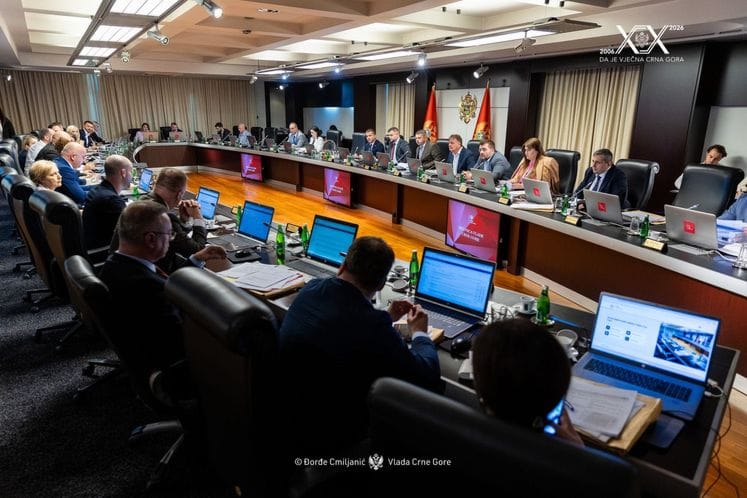
The Montenegrin Cabinet helds its 134th session, chaired by Deputy Prime Minister for Security, Defence, Fight against Crime and Internal Policy Aleksa Bečić. The Cabinet adopted the Foreign Policy Strategy of Montenegro 2026–2029, with the Action Plan for its implementation for 2026. This document provides an overview of objectives, areas and measures of importance for achieving the defined foreign policy priorities of Montenegro, along with the accompanying Action Plan for its implementation, while the established strategic framework will contribute to directing and coordinating the achievement of measurable results in the coming four-year period. Through the Declaration of Independence and the Constitution, the state has clearly defined its foreign policy orientation based on European and Euro-Atlantic integration, the development of good-neighbourly relations, and the strengthening of regional and multilateral cooperation. On this basis, significant and internationally recognised results have been achieved, including membership in the UN, NATO, as well as obtaining candidate status for EU membership. Given that the international environment in which Montenegro operates today is characterised by growing global instability, successful conduct of foreign policy requires a proactive, planned and coordinated approach, based on the ability to timely identify future trends, opportunities and challenges, and to manage them in a manner that strengthens the resilience of society and the country’s international position. The Strategy represents a unified planning document that will ensure direction, continuity, inter-institutional coordination and accountability in implementing foreign policy priorities. The period covered by this strategic document coincides with the period when Montenegro is expected to move from a candidate country to an EU Member State, which is a confirmation of the reform process based on respect for European values. The objective of the Strategy is to further improve the existing foreign policy activities of the state and ensure a coordinated approach in protecting Montenegro’s interests in international relations.
In order to ensure the implementation of the Food Safety Law and full alignment with the European Union acquis within negotiating Chapter 12, the Cabinet adopted:
- Decree on requirements for placing on the market feed intended for particular nutritional purposes,
- Decree on food additives,
- Decree on food flavourings and certain food ingredients with flavouring properties for use in and on food,
- Decree on food and food ingredients treated with ionising radiation, and
- Decree on traceability requirements for sprouts and seeds intended for sprout production.
The Cabinet adopted the Decree amending the Decree on prohibited or permitted methods of use, production and placing on the market of chemicals that pose an unacceptable risk to human health and the environment. The Decree transposes into national legislation bans and restrictions concerning chemicals for which a detailed risk assessment under the centralised EU procedure established that they pose an unacceptable risk to human health and the environment when used in certain ways or when present in certain products. These bans and restrictions apply to certain substances, individually, in mixtures and/or in products of various purposes and types, including, among others, toys, cleaning products, textiles, materials and articles that come into contact with food, electronic equipment, and others. The purpose of adopting the Regulation is full alignment with the latest amendments to relevant European Union regulations in this area, thereby fulfilling the obligation under negotiating Chapter 27.
The Roadmap for the implementation of the remaining requirements of the ESA 2010 Data Transmission Programme and the resolution of remaining methodological issues was adopted. Within the framework of the final phase of accession negotiations with the European Union in the area of Chapter 18 – Statistics, the Roadmap for the implementation of the remaining requirements of the ESA 2010 Data Transmission Programme and the resolution of remaining methodological issues was prepared, representing the second closing benchmark for the provisional closure of this negotiating chapter. The European Commission approved the content of the document and confirmed that it appropriately addresses the fulfilment of the remaining obligations under this benchmark, which represents a significant indicator of the progress Montenegro has achieved in the process of aligning with the European Union acquis in the field of statistics. The Roadmap defines activities, deadlines and responsible institutions for implementing the remaining requirements, with the aim of fully fulfilling obligations arising from the ESA 2010 Data Transmission Programme and closing the remaining methodological issues.
The Cabinet adopted the Fourth Semi-Annual Report on the implementation of Montenegro’s Reform Agenda under the EU Reform and Growth Facility 2024–2027. The Report shows that Montenegro has achieved its most successful result to date, with as much as 83% of obligations fulfilled, further positioning it as a regional leader in EU reforms. The Report states that, out of 41 reform steps, 34 have been reported as completed, enabling European Union support in the amount of EUR 97.3 million. As emphasised during the discussion, reform results have been achieved in the areas of private sector development, digital and energy transition, human capital development, as well as the rule of law and fundamental rights.
The Information on the loan arrangement between the Council of Europe Development Bank (CEB) and the Development Bank of Montenegro for the implementation of the programme “Support to MSMEs in Montenegro – 2”, through the conclusion of the Framework Loan Agreement LD 2143 (2023), was adopted. This concerns a loan arrangement in the total amount of EUR 30,000,000 for the implementation of a support programme for micro, small and medium-sized enterprises. The arrangement represents a continuation of cooperation in the area of economic support, with the aim of improving access to financing for these enterprises, with a particular focus on less developed municipalities, as well as target groups such as women, young people and start-up entrepreneurs. The Loan Agreement takes the form of a Framework Loan Agreement, under which a credit limit of up to EUR 30,000,000 is approved, while funds are disbursed successively, in tranches, in accordance with the dynamics of lending to end users. The total value of the programme financed amounts to EUR 43,000,000, with CEB participation amounting to up to 70% of eligible costs. Loan funds are intended to finance investment projects and working capital of MSMEs, including the purchase of equipment, construction and modernisation of facilities, as well as other costs directly related to project implementation.
The Cabinet adopted the Decree on detailed criteria, method and procedure for exercising the right to reimbursement of part of the funds spent on the production of a cinematographic work. The Decree, among other things, establishes deadlines, the obligation to submit clear evidence of the origin of funds, as well as methods of communication with the Film Centre of Montenegro, in order to make the reimbursement application process more efficient. Certain measures have been introduced to improve the monitoring and control of submitted projects, namely the control of the implementation of the reported production phase and the expenditure of funds, as well as the control of displaying the support of the Centre and the Film in Montenegro programme, which promotes incentive measures for foreign filming in Montenegro. By adopting this Decree, the reimbursement programme is being improved, as it is becoming increasingly popular and there is significant interest in its use, in order to respond to the needs of interested producers, while also preserving the cultural and economic quality of the programme and ensuring the efficient operation of the Film Centre of Montenegro and the Commission for determining proposals for exercising the right to reimbursement of funds spent on the production of cinematographic works.
The Report on the implementation of the Programme for the Protection and Preservation of Cultural Heritage Assets for 2025 was adopted, and the Programme for the Protection and Preservation of Cultural Heritage Assets for 2026 was adopted. This year’s programme envisages co-financing of 54 projects in the total amount of EUR 769,000, in the following areas:
- archaeological and conservation research: 15 projects – EUR 227,000
- preparation of conservation projects and implementation of conservation measures: 28 projects – EUR 450,000
- promotion and presentation of cultural heritage: 11 projects – EUR 92,000.
During the discussion, it was emphasised that the implementation of the projects will contribute to improving the condition of cultural heritage assets, expanding knowledge about the values and importance of cultural heritage, understanding different cultures, strengthening cooperation between competent institutions and owners/holders of cultural heritage assets, as well as bearers/guardians of intangible heritage, and ensuring conditions so that these assets, in accordance with their purpose, serve the cultural, scientific and educational needs of individuals and society.
The Cabinet adopted a positive Opinion on the Draft Law on Amendments to the Law on Protection of Equality and Prohibition of Discrimination, submitted to the Parliament of Montenegro by MP Ilir Čapuni.
The Decision on organising the Public Institution Geological Survey of Montenegro was adopted. In accordance with the Law on Geological Research, the Decision creates the normative prerequisites for organising and operating a public institution that will perform activities of public interest in the field of geological research. The Decision stipulates that the existing Geological Survey Institute Podgorica will be reorganised in accordance with the new legal solutions, in order to ensure more efficient planning, coordination and implementation of basic and detailed geological research of importance for Montenegro, improve the management of geological data and documentation, strengthen state institutional capacities in the field of geology, and provide professional support for the implementation of policies in the area of mineral resources, spatial protection and sustainable use of natural resources. The establishment of the Public Institution ensures continuity in the performance of existing activities, while expanding the competences of the Institute in terms of the implementation of national and international projects, preparation of geological bases and maps, management, processing and preservation of geological documentation, as well as providing professional support to state administration bodies in procedures related to the planning and management of mineral resources.
