
- Home
Prime Minister at the French National Assembly
Prime Minister at the French National Assembly

Spajić: Montenegro’s accession to the EU is an opportunity for Europe to become stronger; Anglade: You are advancing rapidly and can count on France’s support
The support of the French National Assembly is of key importance for the ratification of Montenegro’s accession treaty to the European Union, Prime Minister Milojko Spajić stated in Paris.
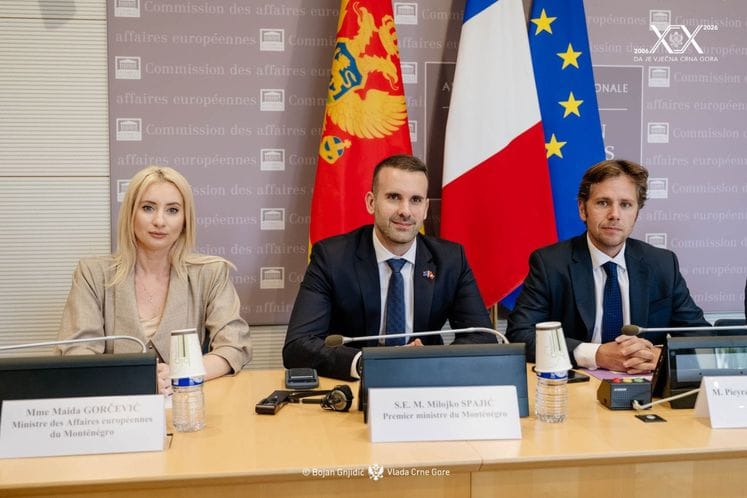
Prime Minister Spajić met at the French National Assembly with the Chair of the Committee on European Affairs, Pieyre-Alexandre Anglade, and members of parliament, emphasizing that it was a great honour to have the opportunity to address the representatives of the French people in the heart of France – a country whose voice, history, and values shape the future of Europe.
Addressing the parliamentarians in French, Prime Minister Spajić stressed that relations between Montenegro and France are not merely friendly, but strategic, founded on mutual trust, continuous political dialogue, and concrete cooperation, which has strengthened across all areas in recent years.
I am fully aware that the enlargement of the European Union raises legitimate questions – some express concern about the Union’s ability to expand without weakening itself. Others fear economic costs or social imbalances. Still others highlight issues of sovereignty and security. Montenegro’s accession is not a risk for Europe. It is an opportunity for Europe to become stronger, Prime Minister Spajić stated, adding that Montenegro is a factor of stability in the Western Balkans.
Chair of the Committee on European Affairs Pieyre-Alexandre Anglade emphasized that Montenegro is advancing the fastest in the EU accession process.
Your determination is delivering results and you are progressing rapidly, as evidenced by the drafting of the Accession Treaty itself. We welcome your efforts and the results achieved during the mandate of this Government, Anglade stated.
Prime Minister Spajić emphasized that Montenegrin society is multiethnic, multireligious, and based on a culture of dialogue and compromise, and that it fully shares European values.
During fourteen years of negotiations, we have implemented profound reforms: strengthening the rule of law, consolidating institutions, combating corruption, and responsibly managing public finances. We are not implementing these reforms merely to satisfy technical criteria; we are implementing them because they are right for our citizens and necessary for Europe, the Prime Minister said.
During his address, the Prime Minister highlighted that Montenegro is already a reliable partner in the field of security and, as a NATO member, aligned with the European Union’s common foreign and security policy, contributes to the stability of the continent in a geopolitical context marked by the war in Ukraine and the rise of hybrid threats.
The Prime Minister emphasized that Montenegro’s ambition is to become a responsible member that respects the rules and is committed to genuine economic and social convergence.
Our integration will not be a burden, but a contribution to a space of shared prosperity, he added.
Prime Minister Spajić stated that Montenegro represents a unique case – the most advanced candidate country, consistently committed to the European path, without waiting for geopolitical circumstances, and prepared to conclude negotiations in the near future.
Our success would also be a success for the credibility of the European Union. Montenegro’s accession will have an impact that goes beyond our borders. It will send a clear message to the entire Western Balkans region: reforms based on the merit principle deliver concrete results. It will strengthen regional stability and limit external influences that do not share European values, the Prime Minister stated.
As he stressed, the enlargement process depends not only on candidate countries, but also on the political will of the Member States.
After more than a decade of effort, we are entering a decisive phase. The support of France and your Assembly will be crucial for the ratification of the accession treaty. Montenegro is not seeking privilege. It is seeking fair recognition of its efforts. We wish to join the European Union not as a passive beneficiary, but as an active partner, ready to contribute to a stronger, more sovereign, and more united Europe, Prime Minister Spajić concluded.
Members of parliament from various political groups expressed interest in Montenegro’s alignment with the EU’s foreign and security policy, regional stability, external influences, as well as economic diversification, the labour market, and the opportunities that Montenegro’s EU membership will bring to young people.
They conveyed that Montenegro can fully count on France’s support on its path toward European integration.
