
- Home
Spajić and Kopman at the Investment Conference in ...
Spajić and Kopman at the Investment Conference in Portonovi: Montenegro is the next EU member, the time to invest is now

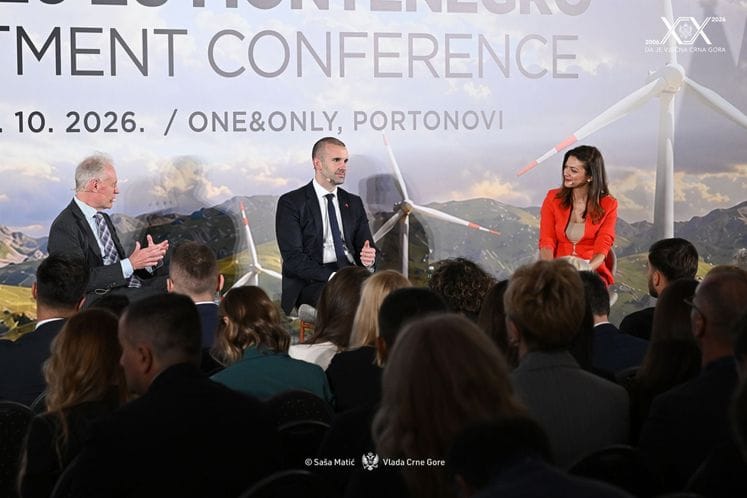
Montenegro is at the final stage of European integration, where the reforms implemented, closer integration with the European Union’s single market and improvements to the business environment are opening up new opportunities for investors. The message that now is the time to invest in Montenegro marked the first panel of the EU-Montenegro Investment Conference, entitled “Reform Momentum – Why Now is the Time to Invest in Montenegro”, held in Portonovi.
Prime Minister of Montenegro Milojko Spajić and Director-General of the European Commission’s Directorate-General for Enlargement and Eastern Neighbourhood Gert Jan Koopman highlighted the importance of the structural reforms implemented, Montenegro’s European prospects, legal certainty and access to the European single market as key factors in investment decisions.
Prime Minister Milojko Spajić stated that, through the reforms implemented and progress on its European path, Montenegro had created the conditions for long-term investment and greater economic competitiveness.
The best time to invest was two years ago, and the best time is also today. The value Montenegro offers investors outweighs the costs of doing business, particularly given the prospect of European Union membership. Sustainable economic development requires continued genuine structural reforms that bring tangible changes to citizens’ everyday lives. Over the past two years and several months, Montenegro has implemented the most demanding reforms on its path towards the EU, Spajić stated.
As he emphasised, European integration brings a range of benefits for businesses, including stronger legal protection for investors and their assets, more efficient institutions, a more predictable regulatory framework and access to a considerably larger market. He particularly highlighted the Government’s commitment to creating a simpler, more predictable and entrepreneur-oriented business environment.
Speaking about Montenegro’s competitiveness, the Prime Minister highlighted the importance of fixed business costs and all the programmes implemented to rationalise them for businesses, as well as the need to ensure faster and simpler access to foreign markets. He assessed that integration into the European single market could help overcome existing constraints, including barriers that hinder companies’ operations across the Western Balkans.
The EU is an essential aspect of Montenegro becoming the Singapore of Europe. European integration, alongside continued reforms and improvements to the judicial system, can provide a foundation for stronger economic development, Spajić emphasised.
The Prime Minister also noted that the diversity of Montenegrin society represents an advantage and offers potential for uniting around a common goal, while stability and trust are important prerequisites for long-term planning and investment.
Director-General of the European Commission’s Directorate-General for Enlargement and Eastern Neighbourhood Gert Jan Koopman assessed that Montenegro was at a historic moment in its European integration and that the conclusion of the negotiation process was rapidly approaching.
He highlighted that, following important decisions adopted by Parliament, Montenegro had made significant progress in the negotiations, stating that 21 chapters had been closed and that, in his assessment, much of the work had already been completed.
The results achieved are not the outcome of short-term activities, but of years of work and the implementation of demanding reforms, including reforms of the judiciary and market functioning. He added that Montenegro’s progress had helped change the views of certain Member States that had previously been sceptical. The time to invest is now, and you need to act quickly, Koopman stated, emphasising that companies investing in Montenegro today could take advantage of opportunities that would expand further as the country moved closer to the European Union.
According to him, a regulatory framework aligned with European rules provides an important foundation for investor confidence. He emphasised that, alongside the adoption of legislation, its consistent implementation and the delivery of tangible results in practice were crucial.
The European Commission will continue its cooperation with the Government of Montenegro to ensure the continuity of reforms even after the conclusion of the negotiation process, which is of particular importance to investors who expect a stable and predictable business environment. Moving closer to the EU can create scope for strong economic growth and new business opportunities, Koopman stated.
The panel was moderated by Tanja Bošković, Regional Programme Manager at GIZ, who noted that, when making decisions, investors consider not only individual projects but also the broader business environment.
She emphasised that countries on their European path reach a turning point when years of reform efforts begin to translate into tangible economic opportunities. In this context, the aim is to bring the pace of European integration into closer alignment with business needs and investors’ decisions.
The panellists agreed that further development of the investment environment would depend on maintaining the reform momentum achieved to date, ensuring the consistent implementation of laws and further improving legal certainty, institutional capacity and access to the European market.
The EU-Montenegro Investment Conference in Portonovi brought together representatives of institutions and the business community to present Montenegro’s investment potential and examine the opportunities arising from the country’s progress towards European Union membership.
