
- Home
Ministry of European Affairs Zenović: Enlargement Brings Benefits to Acceding C...
Zenović: Enlargement Brings Benefits to Acceding Countries, but Also to the EU Itself

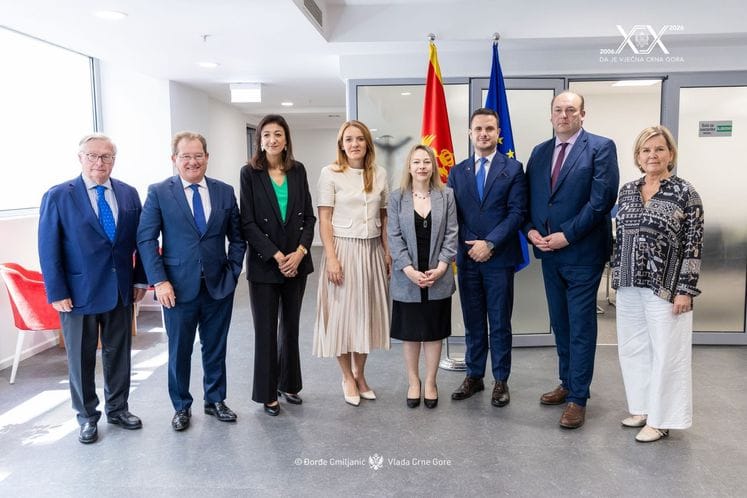
“We have so far viewed the enlargement process only from the perspective of the benefits it brings to countries acceding to the EU. It is now important to demonstrate that this process also benefits the Union itself by making it more inclusive and competitive,” said Montenegro’s Chief Negotiator with the EU, Predrag Zenović.
Today, together with Biljana Papović, State Secretary at the Ministry of European Affairs, he received representatives of the EU Affairs Committee of the Senate of the French Republic.
The delegation of the French Republic consisted of Senators Jean-François Rapin, Chairman of the Senate Committee on European Affairs; Didier Marie, Vice-Chairman of the Committee on European Affairs; Amel Gacquerre, Secretary of the Committee on European Affairs; Louis-Jean de Nicolaÿ, member of the Committee on European Affairs; Michaël Weber, member of the Committee on European Affairs; Marta de Cidrac, Secretary of the Committee on European Affairs and Chair of the France–Western Balkans Parliamentary Friendship Group; as well as Xavier Moal, Head of the Secretariat of the Committee on European Affairs, and Rébecca Smadja, Deputy Administrator of the Committee on European Affairs. The delegation also included Anne-Marie Maskay, Ambassador of the French Republic to Montenegro.

The interlocutors exchanged views on Montenegro’s achievements in the negotiation process to date, ongoing activities, and plans to close all chapters by the end of the year.
Chief Negotiator Predrag Zenović stated that, with 16 provisionally closed negotiating chapters, Montenegro had closed almost half of the entire negotiation framework in a short period of time and that the goal is to complete the accession negotiations by the end of the year.
“Our strategic and political goal is clear: to close the remaining chapters by the end of 2026 and for Montenegro to become the 28th member of the EU by 2028,” said Zenović.
Zenović emphasized that achieving the goals of European integration requires the active and coordinated engagement of all three branches of government working together toward a common objective. As he noted, the reforms are comprehensive, and the Government and the negotiating structure are working diligently in all areas with the aim of entering the EU as fully prepared as possible.

He stated that particular attention is being devoted to fulfilling obligations in the field of the rule of law by shifting the focus from the adoption of legislation to its implementation and the achievement of measurable results.
“We have achieved significant results in the judiciary and in the fight against corruption and organized crime, and we are actively working to meet all final benchmarks in the coming months and ensure the closure of Chapters 23 and 24,” Zenović stated.
State Secretary Biljana Papović emphasized that France’s support for Montenegro’s negotiation process has been continuous, both at the expert and political levels, with the aim of fulfilling the remaining obligations. As she noted, this support is recognized and appreciated by Montenegrin citizens.
Papović stressed that, alongside obligations related to the rule of law, the Government is also committed to reforms that contribute to economic development, emphasizing that the rule of law provides the legal framework for safer and more predictable foreign investment and business operations.

Members of the EU Affairs Committee of the Senate of the French Republic welcomed the results Montenegro has achieved in the negotiation process and stated that the country can continue to count on their support.
Regarding the negotiating chapters, they particularly highlighted the importance of Chapter 27 – Environment, assessing that the role of local communities is very important in this area.
They also pointed to the importance of strong administrative capacities for EU membership and stated that special attention should be devoted to strengthening them in the period leading up to accession to the Union.