

- Home
Press release from the 100th Cabinet session
Press release from the 100th Cabinet session

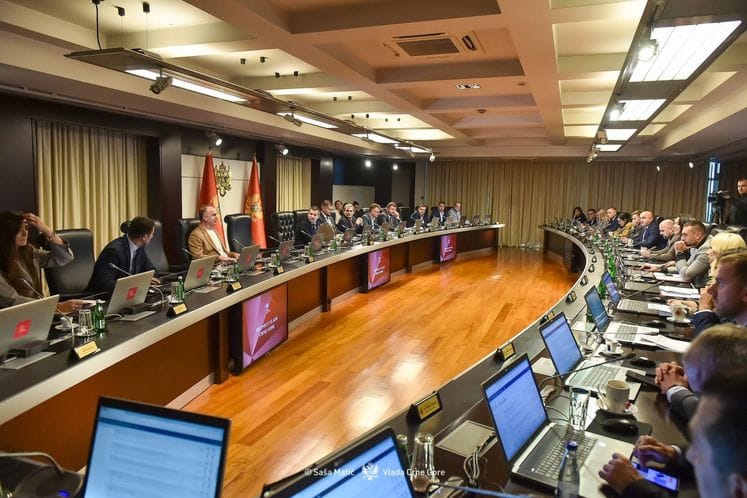
The Cabinet held its 100th session, chaired by Deputy Prime Minister Aleksa Bečić. The Cabinet adopted the Decree on the Detailed Criteria for Determining the Annual Fee for Exceeding the Construction Completion Deadline. In accordance with the Law on Construction of Structures, this Decree prescribes the amount of the annual fee that an investor is obliged to pay for each year commenced if construction of a building is not completed within five years from the date of issuance of the construction permit. The Decree stipulates that the annual fee amounts to 5% of the estimated value of the structure as determined by the revised main project on the basis of which the construction permit was issued. The fee shall be paid to the account of the Budget of Montenegro, and proof of payment must be submitted to the authority competent for issuing the permit. When the construction permit is issued by a local self-government authority, the investor shall pay the fee into the account of that municipality’s budget. The purpose of the Decree is to protect public space, ensure the safety of citizens and surrounding structures, and promote the creation of a human-centered urban environment.
The Cabinet adopted the Decision Amending the Decision on the Designation of Blocks for Hydrocarbon Exploration and Production. Under the current Decision, the Government conducted a mathematical and technical division of the entire territory and offshore area of Montenegro into blocks. The amendment defines the specific blocks to be offered in the upcoming Tender for Hydrocarbon Exploration and Production Contracts, as well as for hydrocarbon exploration itself. The total area to be offered to interested oil companies covers the entire Montenegrin offshore zone, divided into blocks based on a geographic grid. Companies will be able to apply for one or more blocks, and the Government may divide a single production concession among multiple concessionaires, based on the Joint Operating Agreement (JOA) model. The decision-making process took into account the need to avoid affecting other industries, particularly tourism. The boundary lines of the tendered blocks are set 2.5 to 3 kilometers away from the coastline, while ensuring compliance with protected zones (Emerald Network) and current maritime delimitations with neighbouring countries. Given that Croatia, Italy, and Albania have all discovered and produce hydrocarbons, this provides a reasonable basis for Montenegro to expect a positive outcome in the near future.
The Cabinet adopted the Information on the Initial Framework for Negotiations for the Loan Agreement with the International Bank for Reconstruction and Development (IBRD) to finance the Climate Resilient Fisheries and Agrifood Sector Development Project (CRFASD), amounting to up to €33 million, and accepted the Draft Agreement. The main objective of the Project is to strengthen Montenegro’s public institutions in the fisheries and agri-food sectors, improve service delivery, and enhance readiness for EU accession. The Project builds upon the achievements of previous MIDAS I and MIDAS II projects and supports Montenegro in meeting the remaining closing benchmarks for EU negotiation chapters 11 (Agriculture and Rural Development), 12 (Food Safety, Veterinary and Phytosanitary Policy), and 13 (Fisheries).
The Project is structured into the following components:
- Component 1: Fisheries Development and Institutional Readiness for Chapter 13 – €15.22 million
- Component 2: Institutional Readiness for Chapters 11 and 12 – €16.65 million
- Component 3: Project Management and Coordination – €1.05 million
The Cabinet adopted the Information on the Urgent Need to Harmonize Regulations Necessary for the Launch of the Integrated Revenue Management System (IRMS). The Information notes that, in order to operationalize the new IRMS of the Tax Administration, it is necessary to adapt the existing legal framework to ensure effective functioning. Accordingly, the Ministry of Finance has been tasked with preparing amendments to the Law on Personal Income Tax and the Law on Compulsory Social Insurance Contributions; the Ministry of Social Welfare, Family, and Demography with amendments to the Law on Pension and Disability Insurance; and the Ministry of Labour, Employment, and Social Dialogue with amendments to the Labour Law. All amendments are to be proposed under an expedited procedure, with implementation starting from 1 January 2026, to ensure timely activation of the IRMS.
