
- Home
Press release from the 106th Cabinet session
Press release from the 106th Cabinet session

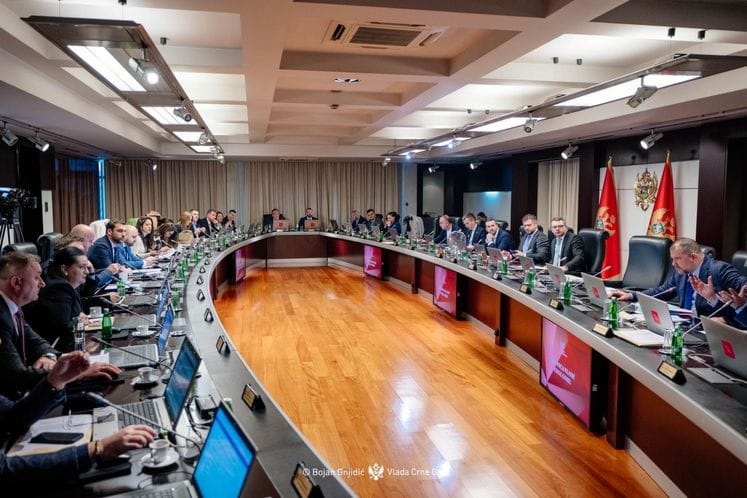
The Montenegrin Cabinet held its 106th session, chaired by Prime Minister Milojko Spajić. The Cabinet adopted the Draft Law on Amendments to the Civil Procedure Law. The adoption of this law aims to align it with Directive 2014/54/EU of the European Parliament and Council of 16 April 2014 on measures to facilitate the enforcement of workers’ rights in the context of free movement, as part of the closure of negotiation Chapter 2 – Freedom of Movement for Workers. The proposed amendments ensure effective access to legal protection for employees and employers from EU Member States, the European Economic Area, or the Swiss Confederation in Montenegro. This enables, in labor disputes, for an employee to be represented by a trade union member, and for an employer to be represented by a proxy of an employers’ association. The objective of these amendments is to ensure that citizens of the aforementioned countries, who work or conduct business in Montenegro, have equal access to judicial protection as domestic entities, in accordance with the principle of equality of parties in proceedings and EU legal standards.
The Cabinet adopted the Draft Law on Amendments to the Law on Peaceful Settlement of Labor Disputes. The purpose of these amendments is to increase legal certainty for parties in disputes, improve working conditions for mediators and arbitrators, and enhance the operations of the Agency for Peaceful Settlement of Labor Disputes, thereby increasing the efficiency of procedures for the peaceful resolution of individual and collective labor disputes, clarifying the normative framework, and aligning it with practice. These amendments align the legal framework with practical needs and international standards in the area of peaceful labor dispute resolution. Additionally, the draft law aligns with EU directives under negotiation Chapter 2 – Freedom of Movement for Workers, specifically Directive 2014/54/EU and Regulation (EU) No. 492/2011 of the European Parliament and Council of 5 April 2011 on the freedom of movement for workers (codification). This enables EU, EEA, and Swiss citizens, as well as their family members, to exercise their rights through the Agency for Peaceful Settlement of Labor Disputes when employed in Montenegro. It also allows them to be selected as mediators and arbitrators under conditions stipulated by this law.
The Cabinet adopted the Draft Law on Amendments to the Law on Construction of Buildings. During the discussion, it was emphasized that the proposed solutions contribute to greater legal certainty and an improved business environment in Montenegro, creating better and safer conditions for capital investment. This law also protects land as Montenegro’s greatest asset. The amendments stipulate that the State Commission will be responsible for performing audit, technical supervision, and technical inspection activities for projects of highways, expressways, main roads, and regional roads, as these are projects of public interest with the state as the investor. This aims to better control construction, monitor progress, and manage costs. The amendments also allow professionals in the legal, economic, and geodetic fields to perform inspection duties, as local governments already practice having lawyers and surveyors conduct building inspections due to staff shortages. Additionally, the deadline for establishing inspection supervision under the Law on Construction of Buildings is extended due to incomplete conditions and a lack of personnel.
The Cabinet adopted the Draft Law on Amendments to the Law on State Surveying and Cadastre of Immovable Property. The adoption of this law is part of Montenegro’s Reform Agenda 2024–2027 under the EU Instrument for Reforms and Growth, specifically Reform 1.1.4 – Improvement of Electronic Cadastre and Spatial Planning, in the area of Policy – Business Environment and Private Sector Development. The amendments aim to enable submission of requests via e-counter to public administration bodies, local governments, legal entities performing delegated state administration tasks, and other entities authorized to make decisions or certify documents that serve as the legal basis for registration, modification, restriction, or termination of rights on immovable property. This simplifies and accelerates administrative procedures, reduces the need for physical visits to the cadastre, and improves efficiency, transparency, and accessibility. Furthermore, the enforcement of the Law on Legalization of Unauthorized Buildings created a need to align existing legislation with these provisions, as the registry of unauthorized buildings represents the first phase in the legalization process. The amendments clarify the registration process for unauthorized buildings in the cadastre and resolve deficiencies identified during the application of the repealed Law on Spatial Planning and Construction and related legal provisions.
The Cabinet adopted the Information on Achievements in Establishing the Western Balkans Cyber Capacity Centre (WB3C). The Centre is a joint initiative of the Republic of France, the Republic of Slovenia, and Montenegro, aiming, as an international organization headquartered in Podgorica, to actively participate in educational activities for all structures of critical infrastructure in the Western Balkans in the field of cybersecurity. According to the Information, the Centre began its programs with the first training on cybersecurity hygiene in public administration in May 2023. Since then, WB3C has developed a wide range of educational programs and training sessions aimed at strengthening institutional and professional capacities in cybersecurity, cybercrime, and cyber diplomacy. The Centre continuously organizes theoretical and scenario-based training tailored for police and judicial structures, covering topics such as cryptocurrencies, crime typologies, handling digital evidence, online sexual exploitation and abuse of children, and open-source intelligence (OSINT). Programs also cover critical infrastructure protection, cyber incident management, the development and strengthening of national and sectoral CERT, CIRT, and CSIRT teams, as well as trainer education to promote cybersecurity hygiene and responsible behavior in the digital environment. Since its establishment, WB3C has trained more than 300 professionals from the Western Balkans, and in 2025 alone, 12 training sessions were conducted on cybercrime and cybersecurity. The session noted that the establishment and development of WB3C confirm Montenegro’s highly important role in regional cybersecurity, contribute to strengthening the resilience of Western Balkan states to cyber threats, and create a recognized international framework for cooperation, education, and development of digital skills based on European values and standards.
