

- Home
Press release from the 112th Cabinet session
Press release from the 112th Cabinet session

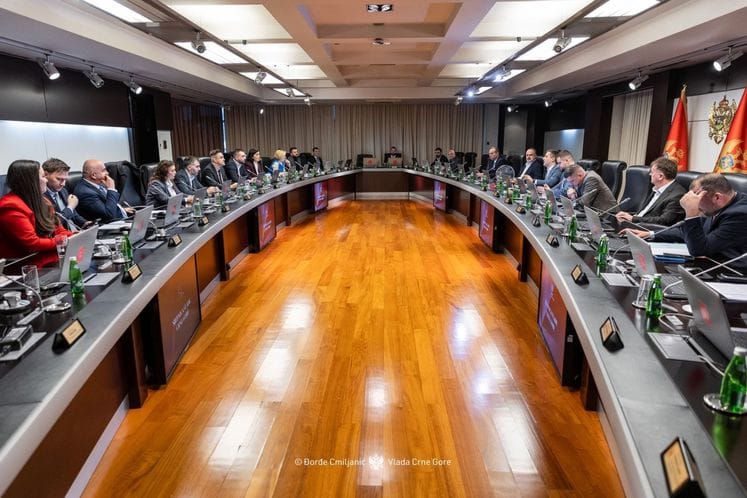
The Montenegrin Cabinet held its 112th session today, chaired by Deputy Prime Minister for Security, Defence, Fight against Crime and Internal Policy Aleksa Bečić. The Cabinet adopted the Draft Law on Amendments to the Law on the Financing of Local Self-Government. During the discussion, it was noted that the existing legal framework does not ensure a sufficiently precise and development-oriented distribution of revenues from the concession fee for the use of airports. Although airports, as assets of general interest, are located within the territory of specific local self-government units, the current system does not provide for an obligation to clearly and purposefully allocate a portion of concession revenues towards the development of local infrastructure and projects of strategic importance for the municipality in whose territory the airport is located. This represents a missed opportunity to more directly link revenues generated from the use of local resources to local development.
The proposed amendments to the Law on the Financing of Local Self-Government aim to achieve the following key objectives:
• ensuring a more functional distribution of revenues from the concession fee for the use of airports, taking into account the fact that airports as assets of general interest are located within the territory of specific local self-government units;
• establishing a clear earmarked component of the fixed part of the concession fee for the use of airports, whereby a portion of the generated revenues is directed towards financing infrastructure projects of strategic importance for the municipality in which the airport is located.
The proposed amendments contribute to the achievement of the Government’s strategic objectives related to more efficient use of public resources and strengthening the development role of local self-government.
The Cabinet adopted the Draft Law on Amendments to the Law on Concessions. The proposed amendment to the existing legal framework, namely the introduction of the possibility for a concession fee to consist of a fixed and a variable component, improves the normative framework governing concession relations and ensures greater flexibility in contracting. Given that concession agreements of varying duration, investment scope and economic structure are concluded, this solution allows for the adaptation of the concession fee structure to the specificities of each individual project. The fixed component of the concession fee ensures stable and predefined revenue throughout the duration of the concession, thereby strengthening the predictability of public revenues. The variable component allows the amount of the concession fee to be linked to the achieved economic effects of the concession activity or other relevant business parameters, in accordance with the contract. In this way, a balanced relationship is achieved between revenue security and the state’s participation in the results of the concession project. The proposed solution does not change the basis for calculating the concession fee, but rather specifies its structure. This ensures the protection of the public interest while preserving an incentive-based and predictable framework for concession implementation.
The Cabinet adopted the Information on the basis for negotiations on the conclusion of a Loan Agreement with the International Bank for Reconstruction and Development (IBRD) for the purpose of financing the project “Montenegro Forests for Shared Prosperity”, in an amount of up to EUR 18 million. The project was prepared through cooperation between the Ministry of Agriculture, Forestry and Water Management and the World Bank during the period 2024–2025. The project is designed to address two key challenges: increasing the sustainability of the forestry sector and enhancing its economic viability. It applies an integrated approach focused on sustainable resource management, more efficient use of higher-value timber, improved quality of employment in rural areas, and enhanced outcomes in carbon sequestration and nature conservation. As stated in the Information, project financing is planned through a credit arrangement with the IBRD, in a total amount of up to EUR 18 million, over a six-year period (2026–2032), with regular monitoring of implementation progress and reporting to the Government of Montenegro and the World Bank’s Board of Directors. The legal basis for concluding the loan agreement is provided by the Law on the Budget of Montenegro for 2026 and the Decision on Borrowing of Montenegro for 2026, which stipulate that the State may borrow, inter alia, for the purpose of financing this project in the specified amount. In accordance with the general lending terms prescribed by the IBRD, the loan arrangement provides for a variable interest rate consisting of six-month EURIBOR plus a variable interest margin determined quarterly. For a loan with a repayment period of 15 years and a grace period of 2 years, the variable interest margin currently amounts to 0.55%. In addition, a one-time front-end fee of 0.25% of the total loan amount is envisaged, as well as a commitment fee of 0.25% on the undisbursed amount at the time of calculation. The calculation of the commitment fee begins four years after the approval of the Loan Agreement by the Bank. All financing terms, including the final text of the Loan Agreement, will be subject to further definition and harmonisation during official negotiations with the IBRD.
The Cabinet adopted the Information on the subscription and payment of ordinary (common) shares of the third issue of the issuer Institute for Physical Medicine, Rehabilitation and Rheumatology “Dr Simo Milošević” Igalo. The Information states, inter alia, that on 29 January of the current year, the Government of Montenegro exercised its pre-emptive right in the first round of recapitalisation by paying EUR 4,605,189.48 into the dedicated recapitalisation account, thereby subscribing to 29,723 shares from the new issue. Given that state funds did not exercise their pre-emptive rights in the first round due to the lack of allocated budgetary resources for that purpose, the Government of Montenegro is required in the second round to purchase an additional 63,457 shares in the amount of EUR 9,831,830.87, up to the amount projected to cover due obligations under the adopted Restructuring Plan in the total amount of EUR 21,436,957.15. Furthermore, the Law on the Budget of Montenegro for 2026 provides for funds to settle obligations under the Institute’s Restructuring Plan, i.e. for its recapitalisation. The implementation of these activities represents a key prerequisite for settling due obligations, stabilising the Institute’s financial operations and creating conditions for the continuation of the implementation of the Restructuring Plan, including the next phase of the investment cycle. In this regard, the Ministry of Finance has been tasked with reallocating the necessary funds for the subscription and purchase of shares in the second round in order to successfully complete the recapitalisation process.
The Cabinet adopted the Information on the establishment of the Commission for the Control of the Use of Tax Exemptions in Agricultural Activities. The establishment of this Commission represents a necessary institutional prerequisite for the implementation of legal provisions in the field of tax incentives in agriculture. By adopting the Decision, the continuation of procedures regarding received applications is enabled, ensuring transparent and lawful application of regulations, as well as more efficient control of investments in the agricultural sector. The Ministry of Agriculture, Forestry and Water Management has received a significant number of applications from legal entities for the exercise of the right to tax exemption in accordance with Articles 31d, 31e and 31f of the Corporate Income Tax Law. The total value of the received applications amounts to EUR 2,611,967.96, indicating significant interest among business entities in using this statutory investment incentive measure in agriculture. In accordance with applicable regulations, the Ministry does not have the authority to independently decide on the validity of received applications; such decisions can only be made by the Commission established by the Government of Montenegro. The Commission for the Control of the Use of Tax Exemptions will play a decisive role in ensuring the lawful and transparent application of tax incentives in agriculture. It is necessary for the Commission to include representatives of the Ministry of Agriculture, Forestry and Water Management, the Ministry of Finance, the Tax Administration and the Agency for the Protection of Competition. This multidisciplinary composition enables a comprehensive assessment of applications, while taking into account fiscal, development and state aid rules. The Commission verifies compliance with legal requirements for tax exemption, conducts on-site inspections and assessments of the factual status of investments, analyses their contribution to the development of agricultural activities, and assesses the accuracy of declarations on received state aid, with the aim of preventing distortions of market competition. Accordingly, the Cabinet adopted the Decision on the establishment of the Commission for the Control of the Use of Tax Exemptions in Agricultural Activities.
The Cabinet adopted the Information regarding the conclusion of the Agreement between the Financial Administration of the Republic of Slovenia and the Customs Administration of Montenegro on the donation of software for the customs information system, and accepted the text of the Agreement. Given that within Negotiating Chapter 29 there is a significant number of IT systems that need to be implemented, as well as the need to achieve a sufficient level of fulfilment of this benchmark by the end of 2026, the Customs Administration has, in the previous period, established communication with the Financial Administration of the Republic of Slovenia (FURS), which has continuously provided support to the Customs Administration in the negotiation process through expert assistance and the donation of IT systems. The Customs Administration expressed the need for the donation of the latest developed FURS systems, in accordance with the Union Customs Code and the latest technical specifications of DG TAXUD, in order to implement them within the Customs Information System following the conclusion of the Agreement. Expert support from the Financial Administration of the Republic of Slovenia during the implementation period was also requested. The Financial Administration of the Republic of Slovenia expressed readiness to continue donating customs systems to the Customs Administration, as well as providing expert support during the system implementation and upgrade period.
The objective of this Agreement is to continue the activities of the Customs Administration related to the implementation/upgrade of the Customs Information System (CIS) with the aim of the provisional closing of Chapter 29 – Customs Union, thereby ensuring:
– implementation of all legal standards regulating international movement of goods;
– interoperability and connectivity with EU customs systems;
– facilitation of legal trade;
– simplification of customs procedures;
– more efficient collection of customs and tax duties;
– collection and analysis of international trade data;
– prevention of dangerous and illicit activities.
