

- Home
Press release from the 113th Cabinet session
Press release from the 113th Cabinet session

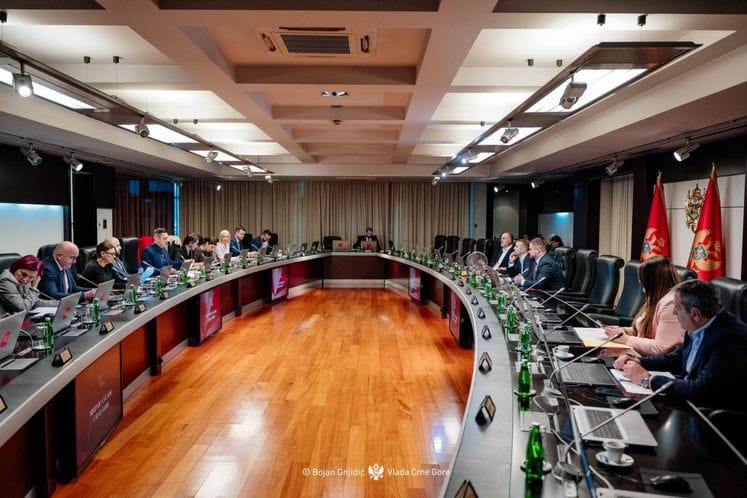
The Montenegrin Cabinet held its 113th session today, chaired by Prime Minister Milojko Spajić. The Cabinet adopted the Draft Law on Amendments to the Law on Road Traffic Safety, together with the Report on the Public Consultation. The adoption of the law aims to create the normative preconditions for improving overall road traffic safety and reducing the number of accidents and injuries on the roads in Montenegro. The proposed provisions also aim to regulate the field of road traffic safety in greater detail and with greater precision, particularly in segments that in practice have caused ambiguities leading to legal gaps and inconsistencies. The Draft Law harmonises the range of monetary fines in relation to the characteristics of offences in order to affirm the principle of prevention over repression and encourage compliance with and settlement of legally prescribed obligations. Existing rules are clarified and new solutions introduced with the aim of enhancing road traffic safety, tightening sanctions for the most serious offences and ensuring more effective implementation of regulations. With regard to restrictions concerning young drivers, the proposal introduces limited freedom of vehicle use (night-time driving ban and engine power restrictions), which represent preventive measures adopted exclusively in the interest of protecting this category of road users, as well as safeguarding the lives and health of all citizens. The engine power restriction aims to enable young drivers to gradually acquire driving experience in technically less powerful vehicles, thereby further reducing the risk of losing control of the vehicle and endangering their own and others’ lives.
The Cabinet adopted the Draft Law on Permanent Seasonal Employment. The adoption of this Law is driven by the need to regulate the status of employees engaged in seasonal work in sectors such as tourism, hospitality, trade, construction and agriculture. Seasonal work represents a significant segment of the labour market in Montenegro, and the lack of an adequate legal framework regulating employment status has created the need for this legislation. The Law aims to provide legal certainty for seasonal workers through the introduction of permanent seasonal employment, enabling continuity of employment in seasonal activities and improving social security by obliging employers to register such employees for pension and disability insurance for an extended duration covering the period when they are not actively working. The Law also introduces an obligation for employers to offer employment to persons engaged in permanent seasonal work in the following season, thereby enhancing labour market security for both employees and employers. Additionally, the Law provides for fiscal incentives and extended pension and disability insurance coverage for employees engaged in permanent seasonal work, contributing to the attractiveness of seasonal employment and reducing the informal economy. As an additional employment activation measure, the Law stipulates that the right to permanent seasonal employment is granted to persons registered as unemployed with the Employment Agency of Montenegro in accordance with the law governing employment mediation and unemployment rights, pension beneficiaries in accordance with the law regulating pension and disability insurance, as well as persons with student status in accordance with the law governing higher education. Persons who establish employment through a permanent seasonal employment contract shall exercise rights and obligations not regulated by this Law in accordance with general labour regulations.
The Cabinet adopted the Information on the Criteria for the Selection of a Supplier or Contractor for the Implementation of the University Clinical Centre Project in Podgorica, pursuant to the Agreement between the Government of Montenegro and the Government of the French Republic. The general objective is to formally establish clear, verifiable and measurable criteria necessary for the Government of the French Republic to submit a list of qualified companies, thereby enabling the launch of direct negotiations and further steps in the implementation of the University Clinical Centre project in Podgorica. This objective is fully aligned with the Agreement ratified by Parliament on 14 October 2025, which entered into force on 31 December 2025 following publication in the Official Gazette and the exchange of notifications.
Among the defined criteria, the proposed company (or companies):
- must demonstrate consolidated annual turnover of at least EUR 500 million, specifically generated in its international construction division, for each of the previous five consecutive years;
- must have access to a banking guarantee line sufficient to issue a performance bond and advance payment guarantee in a combined amount of at least 30% of the contract value or exceeding EUR 100 million;
- must have successfully completed, within the past two years, the design, construction and financing of at least one international healthcare project with: a total value exceeding EUR 160 million; capacity exceeding 400 beds; implementation in accordance with FIDIC contractual rules and with Bpifrance acting as the Export Credit Agency (ECA) for financing;
- must have secured French public financial instruments such as FASEP, an Export Credit Facility, or Treasury loans within the past five (5) years, supporting feasibility studies, design or construction of large-scale construction projects;
- must be established companies with proven international experience exceeding 20 years in the industry;
- must currently have at least one active hospital project contract located within the European Union, designed for 400 or more beds and with a gross built area of at least 50,000 m².
Among the additional criteria, it is stipulated that the proposed company (or companies) must have a publicly undertaken commitment to achieving carbon emission reduction targets, certified by a recognised and independent international organisation, based on clearly defined science-based targets, the use of renewable energy sources or greenhouse gas (GHG) emission reduction targets, and must have headquarters in France.
