
- Home
Press release from the 114th Cabinet session
Press release from the 114th Cabinet session

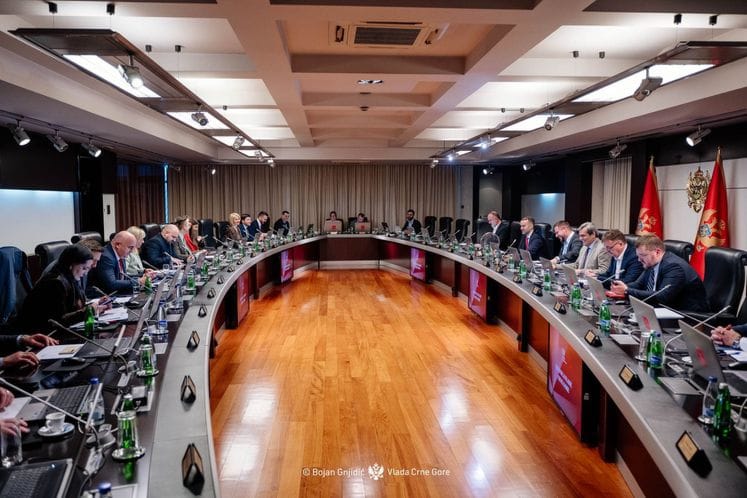
The Montenegrin Cabinet held its 114th session, chaired by Prime Minister Milojko Spajić. The Cabinet adopted the Proposal for the Amendment of the Constitution of Montenegro. In the course of the EU accession negotiations under Chapter 23, Montenegro has already implemented one constitutional reform through the adoption of Amendments I–XVI to the Constitution of Montenegro in 2013, as well as significant legislative reforms in the area of judicial organisation. Considerable activities have also been undertaken to implement the constitutional and legislative framework and to build an institutional judicial system based on the principles of independence and autonomy. Based on these activities, the EU Common Position adopted in June 2024 on the closing of Chapter 23 required Montenegro to amend its Constitution with regard to the composition and appointment procedures of the Judicial Council and the Prosecutorial Council, as an obligation carried over from the interim benchmarks. Regarding the composition of the Judicial Council, the amendments provide that the majority of its members shall be judges elected by all judges; that the Minister of Justice shall no longer be a member of the Judicial Council; and that non-judicial members shall be elected based on professional references and integrity, in accordance with objective and measurable criteria, in order to ensure their full contribution to the exercise of the Council’s constitutional and legal competences.
The election of members of the Prosecutorial Council from among distinguished legal professionals is to be conducted by a qualified majority. Furthermore, safeguards concerning the composition and method of election of the Prosecutorial Council are to be regulated at the constitutional level, in line with the applicable legislation. As emphasised at the session, the Government recognises the establishment of an independent, professional and reliable judiciary as a strategically important area in Montenegro’s further EU integration process, given that only an independent judiciary can serve as the ultimate guarantor of democratic institutional functioning at national, European and international levels, and as a guarantor of citizens’ legal certainty. Accordingly, pursuant to Article 165(2) of the Rules of Procedure of the Parliament of Montenegro, the Cabinet concluded to withdraw from parliamentary procedure the Proposal for the Amendment of the Constitution of Montenegro dated 17 April 2025, submitted to Parliament by Act No. 11-011/25-1301/5 of 28 May 2025. As Parliament had not completed debate on that proposal, which concerned changes to the composition of the Judicial Council in relation to the Minister of Justice, and as additional issues emerged in the EU integration process concerning the need to regulate the composition of the Prosecutorial Council at constitutional level, the new Proposal addresses both matters.
The Cabinet adopted the Draft Law on the Government of Montenegro.
The Draft Law Amending the Law on the Protection of Cultural Property was also adopted. The Constitution of Montenegro recognises cultural heritage as a public good which everyone is obliged to preserve and the State to protect. The most significant part of cultural heritage consists of tangible and intangible cultural property, representing testimony to the past and present of human communities in space and time. The 2026 Government Work Programme envisages amendments to this Law in the fourth quarter, with the aim of full alignment with relevant EU directives. Among other changes, Article 64 introduces the concepts of independent holder and non-independent holder. It is further specified that where a claimed cultural object forms part of a public collection defined as public under the legislation of a Member State and owned by that Member State, or is part of the inventory of churches and other religious institutions subject to special protection arrangements under national law, proceedings for its return may be initiated within 75 years from the date it was removed from the territory of the Member State, unless otherwise provided by an international agreement, except in Member States where such proceedings are not subject to limitation or where bilateral agreements provide for a longer period.
The Cabinet adopted the Draft Law Amending the Labour Law. The primary reason for these amendments, as a closing benchmark under Chapter 19 – Social Policy and Employment, is further alignment of labour legislation with the EU acquis, conventions and recommendations of the International Labour Organization ratified by Montenegro, and other sources of international law. The amendments strengthen mechanisms for ensuring equal pay for equal work or work of equal value, prohibit direct and indirect gender-based wage discrimination, and enhance wage transparency in both public and private sectors. They also introduce minimum requirements regarding paternity leave, parental leave and carers’ leave, as well as flexible working arrangements for parents and carers. Additional criteria for determining the minimum wage are introduced, including purchasing power, and the minimum wage amount is to be set for a two-year period.
The Cabinet adopted the Draft Law on Safety and Health at Work, aimed at further harmonisation with the EU acquis, including relevant Council Directives and provisions ensuring equal protection for fixed-term and permanent employees. The new Law provides a legal basis for adopting secondary legislation governing technical issues, preventive principles and occupational safety measures, in response to technological and labour market developments.
The Draft Law Amending the Law on the Social Council was adopted, ensuring alignment with Directive (EU) 2023/970 on strengthening the application of the principle of equal pay through wage transparency and enforcement mechanisms. The amendments clarify the Social Council’s role in promoting and monitoring pay equality.
The Cabinet adopted the Draft Law on the Ratification of the Additional Protocol to the Convention on the Contract for the International Carriage of Goods by Road (CMR) concerning the electronic consignment note (e-CMR), enabling digitalisation of transport documentation and enhancing competitiveness of Montenegrin carriers.
The Draft Law on Electronic Freight Transport Information (eFTI) was adopted, transposing Regulation (EU) 2020/1056 and establishing a normative framework for electronic exchange of regulatory information in freight transport.
The Cabinet adopted draft amendments to legislation in the areas of technical product requirements, market surveillance, mining, and working time and rest periods of mobile workers in inland waterway transport, ensuring alignment with relevant EU directives under Chapters 1 and 19.
The Roadmap for the Construction and Upgrade of Border Control Posts for veterinary and phytosanitary inspections was adopted, in line with Chapter 12 – Food Safety, Veterinary and Phytosanitary Policy. The Government approved construction at the following locations: Dobrakovo (border with Serbia), Ilino Brdo (border with Bosnia and Herzegovina), Božaj (border with Albania), Kula (border with Kosovo), Golubovci Airport and Port of Bar. The Ministry of Finance is tasked with allocating €13,730,000 within the 2026 Budget and the 2027 Budget Proposal.
The Cabinet accepted the Addendum to the Agreement on Financial Advisory Services between the Government of Montenegro, represented by the Ministry of Transport, and the International Finance Corporation (IFC), extending advisory services related to the concession process for Podgorica and Tivat airports until June 2026, without additional cost to the State.
The Cabinet approved the reallocation of €50,000 from the Current Budget Reserve to the Basketball Federation of Montenegro to support the national sports system and international representation.
