
- Home
Press release from the 115th Cabinet session
Press release from the 115th Cabinet session

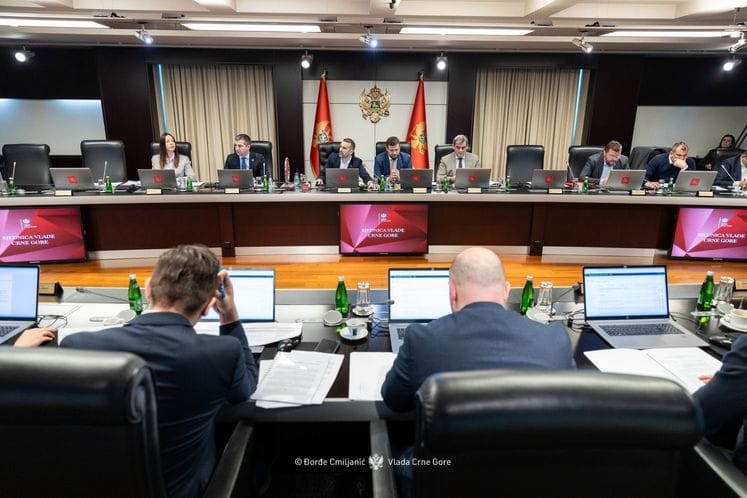
The Montenegrin Cabinet held its 115th session, chaired by Prime Minister Milojko Spajić.
The Cabinet adopted amendments to the Draft Law on Amendments to the Law on Internal Affairs and the Draft Law on the National Security Agency. Following several months of consultations with the European Commission, conditions have been established for the implementation of the General Data Protection Regulation (GDPR), i.e. the protection of personal data. Accordingly, the Cabinet adopted 12 amendments to each of the draft laws, developed through extensive consultations with the competent Directorates-General of the European Commission. The amendments ensure full alignment of the relevant legal frameworks with the GDPR, as part of the obligations related to closing the negotiating chapters, in accordance with the requirements of the European Commission. Within the meaning of the GDPR, personal data include all information relating to the identity of an individual or from which an individual can be directly or indirectly identified. This includes data concerning political views, sexual orientation, race, property status, search history, metadata contained in files created by a specific person that may reveal identity, health data, financial status, movement, habits, and other personal data whose disclosure or misuse could endanger the individual concerned.
The Cabinet adopted amendments to the Draft Law on Amendments to the Labour Law, introducing parental leave in the total duration of 14 months from the date of a child’s birth. Under the adopted amendments, parental leave for mothers remains 12 months, while an additional two months are allocated to fathers as a non-transferable portion of parental leave. The amendments stipulate that the 14-month parental leave entitlement will apply from the date of Montenegro’s accession to the European Union, ensuring full implementation and transposition of Directive (EU) 2019/1158 on work–life balance for parents and carers. The amendments are the result of intensive communication between the Ministry of Labour, Employment and Social Dialogue and the European Commission.
The Cabinet adopted the Draft Law on Amendments to the Law on Waste Management. Based on the conclusions of the Green Parliamentary Group of the Parliament of Montenegro, relating to the legislative framework governing the ban on plastic bags and the use of revenues generated from related fees, amendments were prepared to clarify the allocation of collected funds. Revenues generated from the fee on plastic bags thicker than 50 microns have exceeded projected costs for public awareness campaigns. At the same time, Montenegro faces demanding deadlines in developing waste management infrastructure. The amendments therefore enable collected funds to be directed toward infrastructure projects within the waste management system, ensuring more rational and efficient use of revenues without imposing additional financial burdens on citizens or businesses.
The Cabinet adopted the Draft Law on Management of State-Owned Companies. The law aims to professionalize governance in line with high corporate governance standards recommended by international practice and defined in the OECD Guidelines on Corporate Governance of State-Owned Enterprises. It introduces a transition from a decentralized ownership model to a coordinated centralized model, as a step toward full centralization. The reform is expected to strengthen protection of state assets, improve performance of state-owned companies, reduce costs and fiscal risks, increase state revenues, and enhance public trust.
The Cabinet adopted the Draft Law on Amendments to the Law on Enforcement and Security. The adoption of this Law has been initiated with the aim of aligning national legislation with the relevant EU acquis, as well as further improving the existing legal framework governing enforcement and security proceedings. The proposed legislation enhances the normative framework of enforcement proceedings through a series of interconnected solutions that contribute to greater legal certainty and efficiency. In particular, it introduces, as an enforceable document, a decision of the State Prosecutor ordering the fulfilment of a monetary obligation; specifies that documents issued within the scope of work of a public bailiff must be served personally on the recipient; and regulates service by public announcement in a clearer and more balanced manner. In addition, the amendments address the previously inconsistent application of regulations resulting from differing provisions on the percentage of salary subject to enforcement under the Labour Law and the Law on Enforcement and Security. The proposed solutions also prevent abuses reflected in the avoidance of debt collection through the opening of new bank accounts after existing accounts have been frozen; clarify the provision concerning the sale price in order to eliminate inconsistencies in public sale procedures; enable unequivocal enforcement against accounts of persons who perform economic activities and generate profit, although they are not considered entrepreneurs, while at the same time defining assets that may be exempt from enforcement; and improve the provision on the enforcement of imprisonment as a means of enforcement in proceedings concerning the removal and handover of a child by referring to the application of the relevant legislation.
The Cabinet adopted the Draft Law on Amendments to the Law on Social and Child Protection, in connection with the closing of Chapter 19 – Social Policy and Employment. The amendments promote the best interests of the child, deinstitutionalization, clearer procedures, transparent financing, strengthening of social work centres, and a shift from cash benefits to active inclusion measures. They introduce the Barnahus model for child victims and witnesses of sexual abuse, establish a foster care and family placement centre, and create an institution for protection against sexual violence affecting children, adults, and elderly persons. They also clarify financing responsibilities between the state and municipalities, regulate licensing of foster care service providers, and enhance institutional capacities.
The Cabinet adopted the Draft Law on Homologation of Vehicles, Systems, Components and Separate Technical Units. The law comprehensively regulates administrative and technical requirements for homologation, sale, market surveillance, and conformity of motor vehicles, trailers, two- and three-wheel vehicles, quadricycles, agricultural and forestry tractors, internal combustion engines for non-road mobile machinery, and related components and equipment.
The Cabinet also adopted:
- Draft Law on Working Conditions on Fishing Vessels;
- Draft Law on Air Transport;
- Draft Law on Working Time and Rest Periods of Mobile Workers in Inland Waterway Transport.
The Cabinet adopted a Decision on the Regional Aid Map for the period until 31 December 2027, in line with European Commission Guidelines and EU state aid rules. Given that Montenegro’s GDP per capita (in purchasing power standards) is below 75% of the EU average, the entire territory of Montenegro qualifies under Article 107(3)(a) of the Treaty on the Functioning of the European Union, allowing regional state aid throughout the country.
The Cabinet adopted information approving financial support to Podgorica-based public utility company Deponija for the procurement of a waste tyre processing plant. The Ministry of Ecology, Sustainable Development and Northern Region Development and the Environmental Protection Fund are tasked with allocating €200,000 from the Fund’s budget. The total investment amounts to €880,000 (excluding VAT). The support is provided under a de minimis state aid programme. The plant will enable full-capacity operation, increase recycling rates, reduce manual labour, enhance safety and efficiency, and produce secondary raw materials suitable for industrial use.
The Cabinet adopted information on submitting the proposal to amend Article 86 of the Constitution of Montenegro for opinion to the European Commission and the Venice Commission, in line with recommendations of the Group of States against Corruption (GRECO). GRECO recommended revising the immunity of Government members to explicitly exclude corruption-related offences. The proposed amendment stipulates that the President of Montenegro, the Prime Minister and members of the Government shall not enjoy immunity for criminal offences against official duty, regardless of the prescribed penalty. This reform strengthens accountability of senior executive officials and aligns with obligations under Chapter 23 – Judiciary and Fundamental Rights.
The Cabinet approved information on concluding Memoranda of Understanding between the Ministry of Education, Science and Innovation, Utah Rotary District 5420, and Rotary Club Podgorica and Rotary Club Budva concerning global grants “Let Every Child Learn” and “Knowledge in Hand.” The projects aim to improve education for children with special educational needs through assistive technologies such as tablets, specialized keyboards, Braille printing technology, screen-reading software, and equipment for children with physical disabilities, alongside training for teachers and professional staff to ensure sustainable use of the technology in classroom practice.
