
- Home
Press release from the 85th Cabinet session
Press release from the 85th Cabinet session

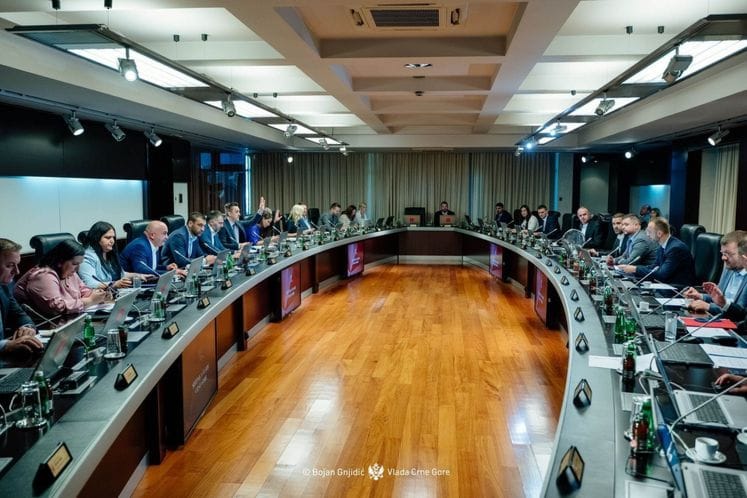
At today's 85th session chaired by Prime Minister Milojko Spajić, the Montenegrin Cabinet adopted the Draft Law Amending the Law on the 2025 Budget of Montenegro. The Draft Law increases total expenditures by EUR 7 million due to technical corrections related to the need to open appropriate budget lines for a number of consumer units to correctly record expenditures. The Draft Law foresees the revenues amounting to EUR 4,026,835,029.68 to be allocated as follows:
Current budget - EUR 1,508,481,087.99,
Funds - EUR 1,304,949,635.05,
Capital budget - EUR 280,000,013.0
Reserve - EUR 43,132,144.94
Financing transactions - EUR 890,272,148.70.
The Cabinet endorsed earlier today the Draft Law on the issuance of covered bonds and the oversight of covered bonds. The Law enhances the regulatory and supervisory framework by strengthening cooperation between two key regulatory bodies in the financial market of Montenegro, namely the Capital Market Authority of Montenegro and the Central Bank of Montenegro, thus establishing a system of dual oversight over credit institutions that issue covered bonds. This contributes to a more favourable position for potential investors, which is why such covered bonds are one of the safest instruments that should certainly find their place on the domestic capital market. Covered bonds represent a relatively secure form of financing, which can contribute to the stability of the capital market by reducing liquidity risk and increasing the resilience of the financial system. By enacting the Law, the State aligns itself with international standards and practices in the area of issuance and supervision of covered bonds, that is, it complies with Directive (EU) 2019/2147 of the European Parliament and Council, thereby ensuring the harmonisation of the legal framework with European standards and facilitating access to foreign markets and investors. Covered bonds are often associated with real estate financing, so the enactment of the Law can contribute to the development of the real estate sector, enabling easier access to capital for construction and renovation projects.
The today’s session also adopted the Draft Law on Accounting, which will enable the improvement of the Law's text, more precise definition of all provisions, as well as easier monitoring of the Law's compliance with any potential new amendments to the EU directives in the fields of accounting and financial reporting. The Law is fully aligned with relevant directives and policies of the European Union in the fields of accounting and financial reporting, except for the part related to sustainability reporting. Namely, the European Commission has initiated the procedure for amending the Directive (EU) 2022/2464 on corporate sustainability reporting, so at this moment it will not assess the compliance of our legislative framework with the provisions of this directive, but had issued instructions not to transpose it into our legislation until the amendments within the 'Omnibus' package are adopted, after which Montenegro would proceed to aligning national legislation regarding sustainability reporting. The adoption of this Law ensures the prerequisites for closing the final benchmark 4 within the Chapter 6 - Economic law.
The Cabinet adopted the Draft Law on Auditing. Considering the importance of quality financial statements for the proper functioning of the market, as well as the fact that a large number of users of financial information rely on the quality of work of authorised auditors and auditing companies, the amendments have been made to the existing legislation in the area of auditing. In this regard, the most important areas of reform are further alignment with the EU legislation, especially with the EU Directive 2014/56/EU and EU Regulation No. 537/2014, which relate to better defining the licensing system for authorised auditors and permits for auditing companies, introducing stricter requirements regarding the independence of authorised auditors and auditing companies, improving organisational requirements for auditing companies, enhancing standards related to the content of audit reports, increasing the role of audit committees, further strengthening supervision over the work of authorised auditors and auditing companies, and establishing a more effective sanctioning system. By adopting the Law, the prerequisites for closing the final benchmark 4 within negotiation chapter 6 – Commercial Law have been fulfilled.
The Cabinet also adopted the Draft Law Amending the Crafts Law. The Law fundamentally improves the regulatory framework in the area of crafts, with a particular focus on aligning with the legal acquis of the European Union, which represents one of the key obligations in the context of Negotiating Chapter 3 – Right of establishment and freedom to provide services. This solution aims to ensure the application of Directive 2006/123/EC on services in the internal market, regarding the removal of legal and administrative barriers that hinder cross-border service provision and to promote competition in the European market, by incorporating certain of its provisions, including the establishment and maintenance of an electronic Register of Craftsmen, which represents an important step towards digitalisation and more efficient management of the crafts sector. The adoption of this law is a significant step towards strengthening the crafts sector in Montenegro, increasing labour mobility, as well as creating a modern and efficient administrative framework in line with European standards.
The today’s session endorsed the Draft Law Amending the General Law on Education. The discussion highlighted that improving the legal framework in the areas of security in educational institutions, digitalisation, career guidance, and transparency in employment create a more modern, functional and fair educational environment. The possibility of online classes in extraordinary circumstances is being introduced, as well as the use of digital textbooks and educational content, while the Ministry acquires the obligation to specify the organisation of digital education through a secondary legal act. The law more precisely regulates the selection of directors of educational institutions by requiring the minister to choose the candidate who is ranked first thus increasing transparency and preventing arbitrariness. Clear rules for hiring and evaluating teachers' work have been introduced, including the possibility of temporarily suspending a teacher against whom a procedure has been initiated due to sexual harassment.
The Law establishes institutional support for career guidance through a special organisational unit of the Ministry in cooperation with the Employment Agency. The text is aligned with EU legislative obligations and eliminates previous barriers to the employment of EU citizens as teachers. The law allows for an influx of funds into the budget through the licensing of extended stays and the renewal of licenses for adult education institutions (every five years), which represents a predictable and controlled income (the Law prescribes a licensing fee of EUR 1000.00 and a fee for license modification of EUR 500.00). By abolishing budgetary funding for private educational institutions, it contributes to a more rational spending of public funds while simultaneously preserving equal conditions in the education market.
The Montenegrin Cabinet also adopted the Report on the completed negotiations for the conclusion of the Agreement between the Government of Montenegro and the Government of the Republic of Croatia on the donation of the property - the Culture House "Josip Marković" in Donja Lastva, Tivat. The Agreement stipulates that the Government of Montenegro donates the mentioned property to the Government of the Republic of Croatia without any additional approvals or permissions, whereby registration will be carried out in the relevant registers. The Government of the Republic of Croatia commits to using the donated property for gathering and promoting cultural content, and preserving the heritage of the indigenous Croatian minority in Montenegro, thus further strengthening bilateral relations between the two friendly countries and their citizens.
The Cabinet also endorsed the 2025 Investment Support Programme. With a view to enhancing access to sources of financing, the Ministry of Regional - Investment Development and Cooperation with NGOs has created the Programme which aims to strengthen economic activity, while enhancing the competitiveness of domestic products and services through investment support in equipment. Investments include all types of investments in new capacities, as well as expansions, renovations, modernisations of existing capacities, or replacements of obsolete, worn-out, or damaged capacities. The 2025 Investment Support Programme amounting to EUR 1.2 million encompasses two programme lines, which emphasise the importance of even regional development through increased support amounts, while maintaining specific incentive support mechanisms for the economic empowerment of youth and women in business.
Program line for support of key investments – EUR 700,000
Program line for small and sustainable investments – EUR 500,000.